Hal Jespersen’s Italian Gothic Line Tour, October 2026 [Part 3]
These are my (Hal’s) notes from a World War II tour in northern Italy hosted by Frank de Planta, covering the Allied advance to and through the Gothic Line starting in the fall of 1944. This will be my third tour with Frank: Operation Dragoon in 2024 and Salerno/Anzio/Cassino in 2025. The notes that follow have been supplemented with some internet research on my part, such as unit designations; Frank’s narrative was not quite as geeky as this may seem. Frank has organized the tour into discrete stands, which is terminology used in military staff rides.
Since this is a lengthy report with lots of photos (iPhone 17 Pro Max), I have broken it into three parts:
Contents – Part 3: British Spring Breakout

Tuesday, October 13 — Eighth Army and the Argenta Gap
Today we are starting our final two days by examining British actions east of Bologna in spring 1945. (Frank offers a separate tour of the fall 1944 British actions along the eastern coast.) It will be nice to drive along mostly flat roads and enjoy beautiful weather for the rest of the trip.
Stand 17 — Forlì Indian Army CWGC Cemetery: Eighth Army’s Half of the Encirclement
We started at the first of two cemeteries in Forlì, the Forlì War Cemetery, which holds 738 Commonwealth burials from the Second World War. Frank gave an introductory overview of the British operations in the spring. Over the winter, progress from Rimini to this area was delayed by river obstacles and personnel shortages. In mid-March, Clark issued the order for Operation Grapeshot, which assigned Eighth Army four phases for its Operation Buckland: V Corps would cross the Senio River and reach the Santerno, with the 8th Indian Division foremost, doing much of the river crossing and early exploitation; the army would then cross the Santerno and advance to the Sillaro; capture Budrio and open the Argenta Gap; and finally establish a bridgehead on the Po with Fifth Army.


In the order of battle, V Corps was on the right, followed by II Polish Corps, X Corps, and XIII Corps on the left flank, liaising with the U.S. Fifth Army. II Polish Corps was to drive toward Bologna. Two divisions had been removed to the Northern Europe theater. The operation was to start on April 9, but Clark ordered two diversionary attacks for April 1. British commandos would attack north at Lake Comacchio, and the U.S. 92nd Infantry Division would attack on the Ligurian coast toward La Spezia. He hoped the Germans would reduce their forces in the center, giving Fifth Army less opposition to its main thrust to the north.
We then drove to Forlì Indian Army CWGC Cemetery. Along the way, we observed the difficulty of crossing rivers with multiple steep flood banks, built by the Romans for irrigation control. The cemetery contains 496 Commonwealth burials from WWII, mostly soldiers of the Indian Army. It also features the Forlì Cremation Memorial, which commemorates nearly 800 Hindu and Sikh officers and men of the Indian Army whose remains were cremated. There is a statue of Sikh soldiers with heroically bulging muscles.


Stand 18 — Lake Comacchio Spit: 2nd Commando Brigade and Operation Roast
We continued to the Po Delta, stopping at the “Peter” Bridge on the Belocchio Canal. In the opening days of Operation Grapeshot, the British 2nd Commando Brigade (Operation Roast, April 1–3) cleared the narrow spit of land between Lake Comacchio and the Adriatic. The object was twofold: protect the army’s right and convince the Germans that the main blow would come on the coast, not through Argenta. Nos. 2 and 9 Commandos crossed the lake in LVTs (amphibious tracked vehicles called “Fantails” by the British and “Buffaloes” by the Americans) and storm boats; 43 Royal Marine Commando attacked the “Tongue”; and 40 (RM) Commando made a feint across the Reno.

The lake was shallower in places than the planners understood, and some of the craft got bogged down in mud on the way to the shore. By April 2, the commandos had reached Porto Garibaldi at the top of the spit, and they were exhausted. But the 29th Panzergrenadier Division was locked up, and nearly a thousand prisoners were taken. The diversion worked well enough that German attention and some reserves stayed tied to the lagoon while V Corps prepared the real gap. We drove on along the north bank of the Reno to lunch in Alfonsine at Il Casolare, another busy truck stop with excellent pasta.
Stand 19 — La Fiorana, Fossa Marina: 24th Guards Brigade and the Bridges into the Gap
The Argenta Gap was a dry corridor only a few thousand yards wide between the Reno and the Comacchio flood plains. The 24th Guards Brigade, with commandos and LVTs, made the amphibious “right hook” (Impact Royal) along the flooded margins to threaten Argenta from the east and seize crossings over the Fossa Marina canal. A foothold was gained short of the objective, but the 15th Panzergrenadier Regiment then blocked the bridges. Renewed attacks on April 15–16 still failed. On the night of April 16, the Guards got across with less trouble but were stopped again a few hundred yards north. Meanwhile, the 78th Division’s 11th Brigade established a small bridgehead east of Argenta, ARK bridges brought tanks over, and the gap began to open.
We followed the 169th Brigade through Menate to La Fiorana Bridge on the Fossa Marina, passing impressive flood banks on the Reno River, 30 meters high in some stretches. It is a bit difficult to envision some of the actions because Lake Comacchio is significantly smaller than it was during the war, with large sections having been filled in for agricultural use. We followed the 1st Buffs (1st Battalion of the Royal East Kent “Buff Howards” Regiment) into La Fiorana, stopping at the pumping station that was a significant landmark during their attack. On April 13, A Company and C Company conducted an amphibious assault by Fantails across the flooded shallows of Lake Comacchio toward the bridge over the Fossa Marina. C Company came under heavy Spandau and antitank fire on landing around midday. Many of its Fantails were hit, platoons were largely wiped out, and the survivors were pinned between the flood banks until they withdrew after dark with only a handful of men left. A Company landed nearby under lighter opposition, got elements ashore, seized its bridge objective, and took about 34 prisoners. The fighting at the landing sites and bridge lasted from the afternoon of April 13 through the night into the early hours of April 14. Casualties were severe, especially for C Company, which was effectively destroyed as a fighting unit in the immediate action, and roughly 50 men of the battalion are buried in Argenta Gap War Cemetery from the broader fighting.

Argenta Gap CWGC Cemetery
The cemetery was chosen by the 78th Division for battlefield burials, and the graves were later concentrated here. It holds many of the commandos and infantrymen killed in the lagoon operations and the fight through the gap. There are 625 burials. One tightly grouped section of six grave markers indicated that an entire Fantail crew had been burned beyond recognition. Two Victoria Cross recipients are buried here: Major Anders Lassen and Corporal Tom Hunter.


Stand 20 — 8th Indian Division at Fusignano: Crossing the Senio and Santerno
On April 9, V Corps attacked on a two-division front, with the 8th Indian Division on the right around Fusignano and the 2nd New Zealand Division on the left. The Indians met stiffer fire on the flood banks than the New Zealanders did, but by dawn on April 10, they held a bridgehead about 2,000 yards deep. The Santerno was crossed on April 11–12, and the 78th Division then passed through toward Bastia and the Reno. (We will be examining that action tomorrow.) The 8th Indian Division was tasked with crossing the Senio and, soon after, the Santerno near Fusignano, supported by one of the heaviest concentrations of artillery and air power used in the Italian campaign. The Senio in particular was a formidable obstacle, its dual raised flood banks turned into fortified lines in their own right. The crossing required careful engineering and infantry work under fire to establish and hold bridgeheads on the far side. We climbed up the very tall and steep flood bank of the Senio and reviewed the assault.

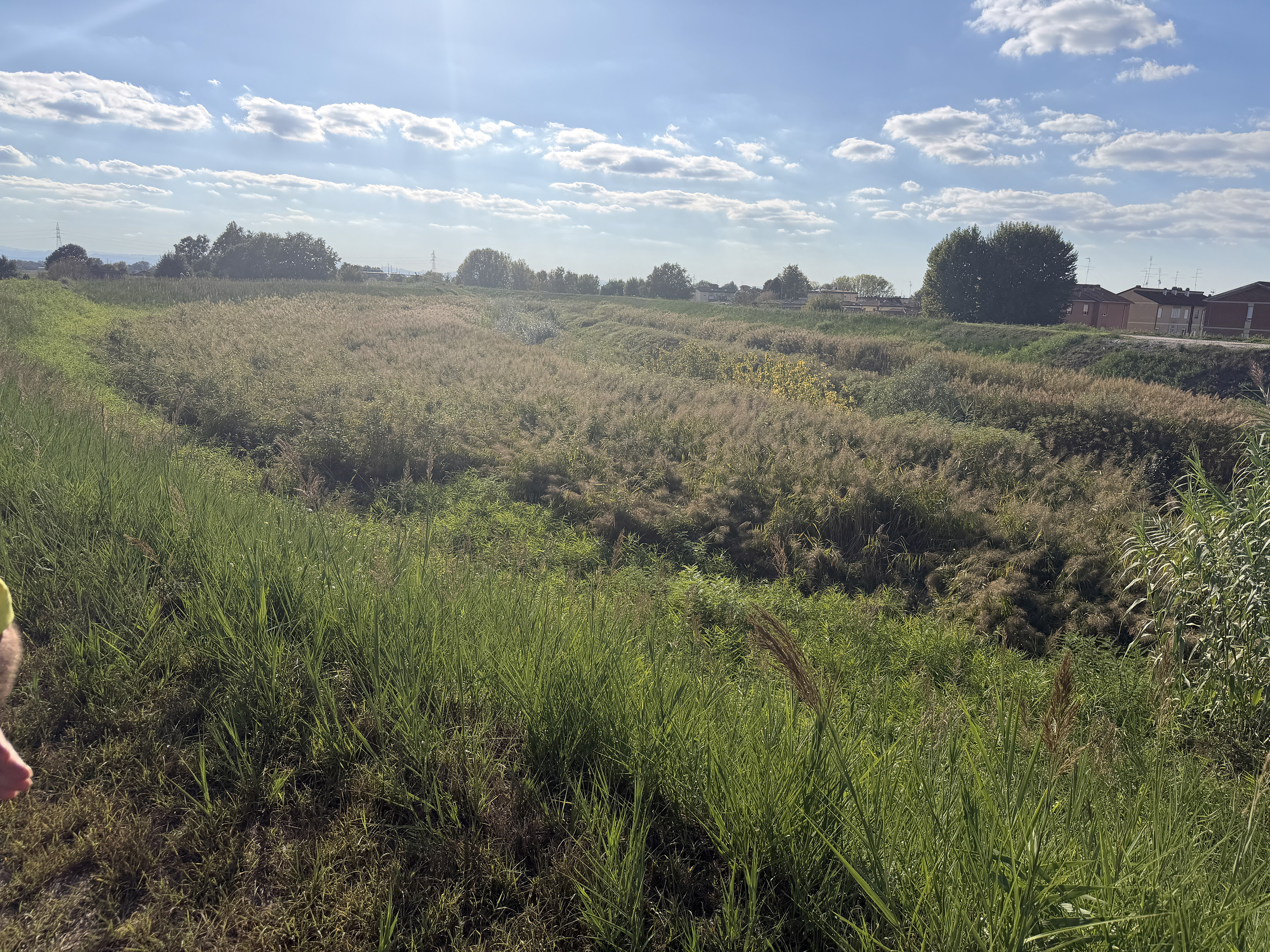
The Indian division was arranged with two brigades up, the 21st and the 19th, and the 17th in reserve, ready to leapfrog to the Santerno after the first two brigades had broken through the Senio. RAF heavy bombers and rolling barrages of artillery pummeled the Germans in turn four times. When it was time for the fifth round, the Germans stayed in their fortifications, but there was no bombardment. The Indians charged the flood bank and, using flamethrowers, overran the positions on both sides of the river. Sappers used explosives to open large gaps in the flood banks. Frank showed us sad photos of a Churchill tank that looked deliberately abandoned down in the riverbed with a bridge on top of it, and then another Churchill tank and bridge on top of that. But happily, it turned out that this was actually two Churchill ARKs (Armoured Ramp Carriers), types of Hobart's Funnies in which a turretless Churchill chassis carried a U.S.-made ramp that was specifically designed for this purpose, and was not tank cruelty at all.

We spent the night at the Locanda Merlaschio B&B in Faenza, a comfortable big house nestled into a vineyard, and we dined in their restaurant that evening.

Wednesday, October 14 — Exploitation to the Sillaro
Stand 21 — Mondaniga: 78th Division through the Argenta Gap
This morning, we started following the 78th British Infantry Division of V Corps. We began at the Senio around Cotignola and passed through Lugo, Mondaniga, Massa Lombarda, and Lavezzola on the way to Bastia, on the left side of the Argenta Gap.
On April 12, with the 8th Indian Division’s Santerno bridgehead firm, the 78th, which was on the Indians’ left, was ordered through at once. The 36th Brigade expanded the bridgehead west, and the 38th (Irish) Brigade crossed in the evening and paused around Mondaniga, too late to launch the full northward attack that night. The division advanced with the 36th on the left and the 38th on the right. The critical bridge over the Reno at Bastia had been blown up, so the 11th Brigade moved out of reserve and made a lengthy U-turn to the east to bypass the destroyed bridge. By this time, the 56th Division advancing along the Reno had secured the area, as we saw yesterday, and engineers were able to build bridges to let the 36th and 38th Brigades drive into the gap.

Stand 22 — Medicina: 14/20th King’s Hussars Battle Group
We drove south to Conselice into the Polish sector. East of the Fifth Army sector, II Polish Corps and the 43rd Gurkha Independent Brigade were crossing the Sillaro. On April 16, after the 2/10th Gurkhas secured a bridgehead, the 2/6th Gurkha Rifles mounted up in Sherman Kangaroos as part of the 14/20th King’s Hussars Battle Group and drove on Medicina to protect the Polish right and block a counterattack. (Kangaroos were Sherman tank chassis without turrets, used as early versions of modern armored personnel carriers.) The battle group, which was in mobile pursuit mode, pressed forward through difficult vineyard and ditch terrain. We saw crossing points of an intermittent stream, essentially a ditch, called Scole Sillaro, which caused delays in the advance. Around midday they were delayed near Madonna del Silvaro by German self-propelled guns, which were knocked out.

We passed through Palazzo and soon reached the town of Medicina. C Squadron of the 14/20H (under Major Browne) and B Company of 2/6 GR charged into the town. Medicina’s narrow streets and cellared buildings favored close-quarters defense. Tanks used their 75 mm guns to blast holes in walls for the infantry, while Gurkhas cleared buildings house to house with grenades, rifles, bayonets, and kukri knives. Fighting extended into cellars, attics, and even rooftops against small units of the German 4th Parachute Division. Resistance was fierce at first; one Hussar tank (Major Browne’s) was hit by an antitank rocket in the town square. The successful capture of the town by midnight allowed the Poles to cross the Sillaro and take Bologna on April 21.
Museo Memoriale della Libertà, Bologna
We drove into the outskirts of Bologna to visit an unusual museum. It is similar in layout and spirit to the Museo Piana delle Orme near Anzio, which I visited with Frank in 2025. We started with a movie about the liberation of Bologna that was filmed personally by the museum founder. Some of the video was pretty low quality, but he used an abandoned German camera and was the only one filming during this period. There were many shots of GIs marching and driving through the streets, met by enthusiastic local residents, but there were also some views of bombing in the days preceding. There was also film of the trial and firing squad execution of a captain of the Fascist Squad. Elsewhere in the museum, we saw displays of dozens of plastic tank models and took a guided tour of five dioramas with impressive sound effects, depicting the hardships of the civilian population, an air raid, the Battle of Porta Lame between Germans and partisans, and a view of the 10th Mountain Division attacking in the foothills of Monte Belvedere. In a large building and also in an outdoor display, there are dozens of military vehicles, many of them in derelict condition, and some of them for sale. The majority were trucks, but there was an interesting M4 Sherman. I looked up its registration number, and it is supposed to be an M4A3 with a hull intended for a 105 mm cannon, but it had been fitted instead with a 75 mm high bustle turret. Our guide told us that the Sherman was in operating condition and had appeared in a couple of movies, along with a few of the other vehicles on display.


We did not cover this directly in the tour, but Polish troops of the 3rd Carpathian Rifle Division, part of General Władysław Anders’s II Corps, entered Bologna on the morning of April 21, moving in from the southeast along the Via Emilia (Highway 9). They reached the city center at about the same time as elements of the U.S. 34th and 91st Infantry Divisions, who were coming in from the south, and Italian partisans had already seized parts of the city and were fighting the last German rear guards. The Poles were the first Allied troops to reach the Piazza Maggiore, and a Polish flag was raised over the city. The Bolognese gave the liberators an enthusiastic welcome, and Bologna’s later gratitude to the Polish soldiers is still commemorated in the city today.
We drove to an area near Marconi Airport and had a light lunch at Bar Lippo. Nearby in Longara was our final hotel of the trip, a B&B called La Torre di Longara. It is in a 16th-century palazzo that has been thoroughly modernized inside and is quite comfortable (but with poor Wi-Fi). Dinner was at the nearby Trattoria Da Gianna. The food was really excellent, but the arrival of twenty middle-aged Italian men laughing and shouting at two tables next to us meant that we could barely hear ourselves think. Not a venue for quietly contemplating the successes and costs of the Italian campaign.
Thursday, October 15 — Rome and Home
Frank drove us to the airport, and I took a monorail called the Marconi Express from there to the central Bologna train station. It’s sort of a grungy station with very few amenities. Next, Trenitalia Frecciarossa (“Red Arrow”) direct service to Roma Termini. Very comfy in the Area Silenzio. Then the Leonardo Express to Roma Fiumicino (FCO), all in all a 3.5-hour journey. FCO is super crowded and chaotic. The good news is that the EES exit queue had about 100 non-EU folks in line, but I waited only nine minutes and after scanning my passport and posing for a photo, there was no need to talk to a person. I am pretty sure this is the way it is supposed to work in Europe eventually. The ITA lounge was also crowded, but they had decent Pizza Margherita slices available. I actually had a dearth of pizza this week, involuntarily overdosing on pasta.
My United direct flight to San Francisco, arriving early evening, was comfortable and on time without incident. I took a photo of some interesting mountains in Greenland, which is notable because in all my previous flights the island has either been in the dark or under solid cloud cover. A geologist friend told me that it shows glacial flood basalts carved into horns and cirques.

I had an excellent time on this tour with Frank and friends. He continues to be an outstanding guide for deep dives into military history and understanding British military organization and culture. We ate in many excellent restaurants and had good to very good lodging. Although there was a lot of tiring driving on windy mountain roads, it was great to see so many places that I had never encountered and explore history with which I was not familiar. It was very sobering to see the severity of the terrain to be conquered and the misery that our soldiers (and the civilians) had to endure for victory.