Hal Jespersen’s Italian Gothic Line Tour, October 2026 [Part 1]
These are my (Hal’s) notes from a World War II tour in northern Italy hosted by Frank de Planta, covering the Allied advance to and through the Gothic Line starting in the fall of 1944. This will be my third tour with Frank: Operation Dragoon in 2024 and Salerno/Anzio/Cassino in 2025. The notes that follow have been supplemented with some internet research on my part, such as unit designations; Frank’s narrative was not quite as geeky as this may seem. Frank has organized the tour into discrete stands, which is terminology used in military staff rides.
Since this is a lengthy report with lots of photos (iPhone 17 Pro Max), I have broken it into three parts:
Contents – Part 1: Breaking the Gothic Line and the Winter Front

Thursday, October 8 — to Bologna
I was already in Europe for a Normandy DUKE tour, so I flew on Air France from Paris (CDG) to Bologna, arriving late afternoon. I checked into the “Fly On Hotel” at the Bologna airport, which required a 2-km walk on a busy road with no sidewalk, dragging my bag, since their advertised shuttle service did not run from noon until 9 p.m. It was a time to relax and prepare for the start of the tour Friday morning. Dinner in the hotel restaurant was a pinsa, which is a variation on a pizza that has a slightly different dough composition, more like a flatbread.
Friday, October 9 — Breaking the Gothic Line
Frank picked me up in a van at the hotel at 9:45 a.m. Our group consists of Dennis and Jan from Arizona and me. We headed south through the northern Apennines, passing through a lot of tunnels, and stopped at Colle Barucci overlooking the Sieve Valley for an introduction, accompanied by Frank’s excellent map and photo package.
Stand 1 — Colle Barucci: Fifth Army prepares to cut the Gothic Line
By late summer 1944 the Allies had pushed north of the Arno River, an advance of the U.S. Fifth Army I followed with Frank last year, but the German Gotenstellung (Gothic Line) still barred the way into the vital Po Valley. Field Marshal Albert Kesselring had spent months turning the northern Apennine range into a fierce defensive barrier. The 320-km Gothic Line made use of rugged terrain: peaks, ridges, and valleys. It included over 2,400 machine-gun posts, 479 artillery sites, around 4,000 bunkers, and 16,000 sniper positions. Nearly 100,000 explosive devices, including antipersonnel and antitank mines, were laid, along with hundreds of kilometers of barbed wire. In the eastern sector where the Brits operated, antitank ditches were dug to block armored vehicles at lower altitudes.
General Harold Alexander, the 15th Army Group commander, planned a combined offensive that would push north from Florence along the axis of Pistoia to Dicomano, with Mark Clark’s Fifth Army on the left and Oliver Leese’s British Eighth Army on the right. However, Leese convinced Alexander to move the British to the east coast of Italy, while Clark’s army would demonstrate or feint in an attack up the Futa Pass, causing Kesselring to withdraw forces from the east and allowing the British to advance north. Clark agreed to this change only on the condition that the British XIII Corps would be transferred to his command.

Clark’s army was considerably diminished from its strength in the initial invasion of Italy because four French divisions and three U.S. divisions were withdrawn from the theater to participate in Operation Dragoon, the Allied invasion of southern France in August 1944. Thirty-three artillery battalions had been reduced to 22. At the same time, Kesselring’s army, in defensive positions, had gained six additional divisions. Clark had to plan his diversionary offensive with this strength disparity in mind.
Highway 65, the direct Florence–Bologna road through Futa Pass, was the obvious axis, and therefore the most heavily fortified, a situation verified by Ultra intercepts. Clark therefore planned to feint at Futa while driving his main blow on Highway 6524 through the less obvious Il Giogo Pass to the east, outflanking the strongest works and opening a road toward Firenzuola and, beyond it, Imola.
Our next stop was the Gothic Line Museum in Ponzalla. Frank explained that northern Italy was more partisan than in the south, and that people there are more enthusiastic about volunteering to memorialize the war. The Gothic Line is held in higher prominence in Italy than the Gustav Line, such as around Cassino, and there are more monuments to battles and units in the north than in the south. This museum is an indication of that interest, as it was created and is manned by volunteers. It is a really nice small museum with thousands of artifacts, including weapons, uniforms, radios, equipment, and the day-to-day necessities for soldiers, such as supplies and rations. It also features lots of good maps and campaign information. When we arrived, there was a big bus outside, and the National World War II Museum had a group touring through the museum. (Their tour is shorter and considerably less detailed than the one we have embarked upon.)


Stand 2 — 363rd Infantry Memorial: II Corps Plan for Il Giogo Pass
We drove toward Il Giogo Pass to a monument to the 363rd Infantry Regiment, a California National Guard unit that was part of the 91st Infantry Division, II Corps. We had a clear view of Monte Altuzzo with the lower Peabody Ridge on the left. It was sad to see that the monument was pretty dilapidated, being maintained entirely by volunteers from the local Lions club.


We discussed the II Corps attack plan, in which the 91st Division would assault Monticelli and the 85th Division would assault Altuzzo. While the 85th was a seasoned veteran of the Italian campaign, the 91st was green, new to combat. After crossing the Sieve River, the 91st left Highway 65 and followed the secondary Route 6524 toward Il Giogo. The German outpost line in the low hills gave way more readily than expected; the main line, on the 3,000-foot Monticelli massif west of the pass and Monte Altuzzo east of it, did not. The II Corps plan was to have the 91st develop the position, then pass the 85th through on a narrow front to take Altuzzo while the 91st took Monticelli. A holding attack by the 34th toward Futa would pin German reserves.

We also stopped not very far away at another minor monument, to the 338th Regiment, which was part of the 85th Division.

Stand 3 — Monte Altuzzo: 91st and 85th Divisions Assault the Heights
We stopped outside a fancy restaurant where the World War II Museum folks were dining and instead hiked up a relatively steep and muddy slope to reach the top of Monte Altuzzo. From there, we got a fabulous view of the valley and saw what the German 4th Parachute Division would have seen. The mountain range in the distance is the one that separated us from Florence. We could also see a motorcycle test track, part of the Mugello Circuit.


The first contacts on September 12 were sporadic; by September 13 both Monticelli and Altuzzo were still in the hands of the 12th Parachute Regiment, with one battalion defending each mountain. The 85th Division (337th, 338th, and 339th Infantry Regiments) was given Altuzzo; the 91st (361st, 362nd, and 363rd) Monticelli. Attacks on September 13–14 fragmented. The Germans, late to realize this was the main effort rather than a diversion, began feeding in reserves. On Altuzzo, companies split toward the summit and the western spur soon nicknamed Peabody Peak after the company commander stranded there, believing it the true summit. Frank emphasized that all of these mountainous positions were interlocked, and the U.S. would have to seize all of them to avoid being attacked from the others. On September 16 Company K of the 338th finally took the crest of Altuzzo, where there currently stands a large cross. The next day the 85th seized Pratone and Verruca on the right, and the 91st took Monticelli. By the morning of September 18, II Corps held a seven-mile stretch of the Gothic Line astride the pass. The 85th and 91st were exhausted, but the 34th and 88th divisions were still available. The German I Parachute Corps was ordered back to the heights north of Firenzuola, and Futa Pass fell almost by default. The entire affair cost II Corps more than 2,700 casualties.

This is a pretty isolated area without a lot of restaurant opportunities, but we eventually found a take-out lunch at a supermarket in Firenzuola. We then took a very winding road and reached our hotel for the first night, Hotel Musolesi in a small town, Madonna dei Fornelli. It was quite basic with a few warts. Dinner was next door at Albergo Ristoranti Poli.
Saturday, October 10 — Pursuit, Delay Lines, and the Winter Front
On the way north to the Futa Pass, Frank explained that IV Corps did not have enough power to carry the attack, so the job fell to II Corps, which put all four of its divisions in line. The advance would run out of steam before it reached Bologna. After Il Giogo fell, the Germans had no reserves, so they drew back from Futa and established four defensive lines to the north.
Futa Pass German Cemetery
The Futa Pass German Cemetery has dramatic architecture on a high hill overlooking the pass. It was established in the early 1960s and holds 30,713 burials, the largest German cemetery in Italy. Inside is a darkened room in which a number of division monuments are on display.


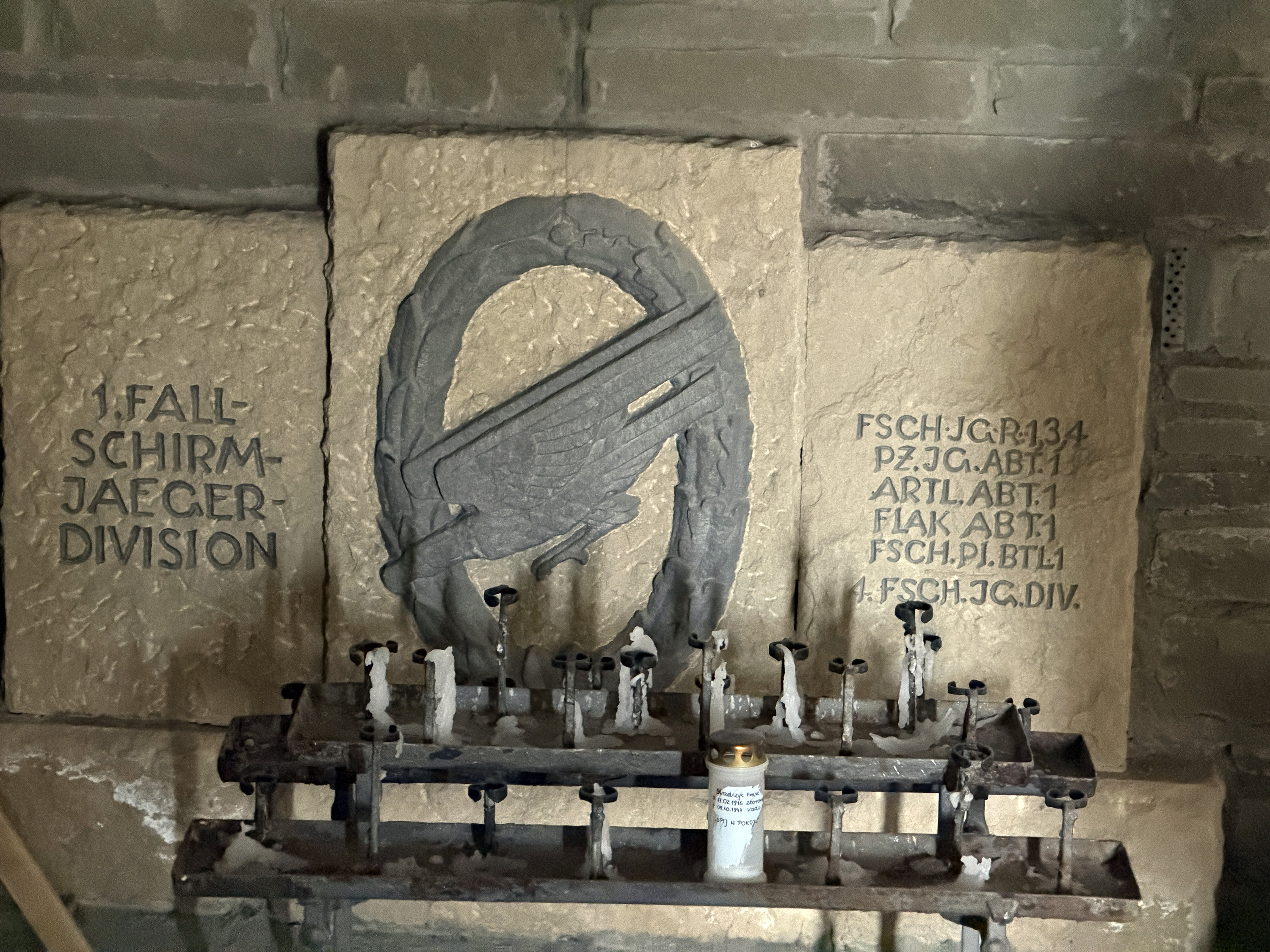


Frank explained that, with the Gothic Line pierced, II Corps had a choice: drive straight up Highway 65 or send a division northeast down the Santerno River toward Imola. Clark did both. The 88th was sent toward Imola, while the 34th, 91st, and 85th were to converge on the mountains that guard Radicosa Pass: Monte Canda, Monte Oggioli, and Monte Bastione. The fighting of September 23–30 was for those peaks, not for a prepared line of fortresses. Once they fell, the Germans pulled back about four miles to a delay line through Monghidoro. We followed Highway 65 to Radicosa Pass, the route of the 91st Division. II Corps commander Keyes put only two regiments of each division in line, with the other resting. This obviously affected the combat power of the corps.

Stand 4 — Radicosa Pass: Opening the Road toward Bologna
Control of Radicosa put II Corps on the direct road to Bologna, but the “road” was still a succession of ridges, each of which the Germans assigned one division as the primary defender. Their strategy was to hold the Americans in the mountains, preventing them from reaching Bologna until winter, and then rely on the weather to do the rest.

Stand 5 — Alpe di Monghidoro: First Two Delay Lines, October 1–9
North of Radicosa the Germans improvised three successive delay positions: Monghidoro (October 1–4), Loiano (October 5–9), and then the Livergnano escarpment. The German 4th Parachute and 362nd Grenadier Divisions, already worn from Il Giogo, held Monghidoro until the night of October 4. The 91st Division fought house to house for the village. A dawn attack on October 5 put the 362nd Infantry into Loiano, and a counterattack was beaten off and an outpost line established beyond the ruins. By then II Corps had established a ten-mile front. We took a hairy dirt road to the top of Monghidoro and passed monuments to the victims of war along the way. Casualties ran to 550 Americans per division per day. A deception about an Allied amphibious operation caused Kesselring to worry that he might be hit in the flank, but the Allies had no shipping available to achieve it.


Stand 6 — Monte Castellari: The Third Delay Line at Livergnano, October 10–15
Monte Castellari was an outpost of the Livergnano line, a ten-mile east–west escarpment of isolated peaks that was the last serious mountain barrier before the approaches to Bologna. The German position was organized on the slopes of the mountain, which lies between Loiano and Livergnano (commonly known as “Liver and Onions” by the GIs). The 91st Division had to clear it before the main escarpment could be turned, and fog, rain, and German artillery made every movement either visible or impossible. On the morning of October 7, hoping to surprise the enemy, the Allies attacked without an early artillery barrage. The plan did not succeed, and over the following days of harsh weather, U.S. artillery fired an average of 4,500 rounds per day at Monte Castellari alone. At 4:30 a.m. on October 8 the attack was reinforced by the 2nd Battalion, whose soldiers, cold and wet, began a two-day attack in fog and full darkness. On October 9 they finally placed a patrol on the peak, using rope ladders to climb the almost vertical face. They found that the 145th Regiment of the German 65th Division had withdrawn during the night, leaving the highest hill between Loiano and Livergnano. The 91st Division lost about 1,400 men in those days, far fewer than the estimated German losses. Those losses caused Kesselring to change his strategy: he limited counterattacks to a single attempt and, if it failed, simply withdrew. We had lunch at Trattoria Naldi in Sorgente della Castellina, a traditional Italian trattoria with a grandmotherly proprietor who offered a very limited but excellent pasta menu.
Stand 7 — Santuario del Monte delle Formiche: 85th Division, October 10
We drove to Monte delle Formiche, which has a sanctuary church and tower on the crest and dominates Highway 65 and the Idice valley. It was the 85th Division’s main objective in the third phase. On October 10 the 2nd Battalion, 338th Infantry, attacked after the 3rd Battalion had seized a line of departure. Companies E and G worked up the slopes and by late afternoon held the crest and a chapel, taking dozens of prisoners. German reverse-slope errors helped, and successive counterattacks did not recover the hill. Taking it did not “break through” Livergnano by itself, but it unhinged the center of the delay line and forced the withdrawal that followed.


Frank noted that around this time Prime Minister Churchill asked Washington for two or three more divisions for the Italian campaign. Chief of staff George Marshall made it clear to President Roosevelt that the northern European theater took priority, and the request was denied, which put the Italian campaign in a no-win position. Nevertheless, Alexander and Clark developed a rather fanciful plan to encircle the Tenth Army using both the 5th and 8th Armies, which would simply break out of the hills, something they were incapable of doing at the time. The Germans were also very short of men and considered withdrawing to the Alps, but Hitler refused. His political reason was to support Mussolini, but the more practical reason was that the fertile Po Valley was needed to feed the Reich.
Stand 8 — Monte Castellaro: 2nd Royal Scots, November 25–28
We drove along a high ridge road that followed some of the Allied positions to reach the Monte Grande sector, and now and then we could see the Po Valley less than ten miles to the north. We passed the intersection of a dirt road that was the end of a supply highway called the Boston Byway. We drove along the shoulder of Monte Grande and then moved north to visit two smaller mountains in the ridge, Calderaro and Castellaro. These were initially held by the 88th Division and formed a salient, the northernmost part of the U.S. line, which Frank called a lozenge. The U.S. troops were rotated out and replaced by the 2nd Royal Scots from the British XIII Corps. Their battalion headquarters was at the village of Callenco, and the companies were split among Rovine, the eastern shoulder, and an isolated summit position. B Company, only 40 strong, also manned a liaison post at Casa Nuova toward the Americans in the valley.


On November 28, after a day of more than 400 mortar bombs, German patrols moved between Casa Nuova and the main company. The Scots recaptured ground in a night action that earned a Military Cross and a Military Medal, but they lacked the numbers to hold the summit they had retaken. Calderaro and Castellaro were lost to the Germans, but the dominant Monte Grande remained the northernmost US position for the winter.
Stand 9 — Monte Grande and Monte Cerere: 19th Indian Brigade, December 11–12
Monte Grande and Monte Cerere, some 4,000 feet up and only about seven miles from Bologna, dominated the lateral communications of the winter line. The 19th Indian Brigade (8th Indian Division)—the 1st Battalion, Argyll and Sutherland Highlanders, 6th Royal Frontier Force Rifles, and 3/8th Punjabis—was rushed from the Eighth Army sector to reinforce the 1st British Division. By December 6 the brigade had taken over, with the Argylls on Frassineto Ridge, the Frontier Force on Cerere, and the Punjabis on Grande. We stopped at the only British Indian Army monument in Italy, which memorializes this brigade. (There is now an Indian Army monument in Cassino, but it was erected by the Indian Government in 2022, not by the British Indian Army.)


On December 12, after a half-hour mortar and artillery preparation and a smoke screen, the 3rd Battalion of the 1st Parachute Division, made up of Cassino veterans, attacked Cerere, Casa Nuova, and Frassineto. The assault reached within a few hundred yards of the Cerere summit before the Frontier Force and supporting artillery broke it, and the paratroops left around a hundred dead. We then drove to Castel San Pietro Terme and checked in to the Hotel Castello, which was considerably nicer than last night’s hotel. Dinner was downtown at Osteria Il Sapore Antico.