Hal Jespersen’s Italian Gothic Line Tour, October 2026 [Part 2]
These are my (Hal’s) notes from a World War II tour in northern Italy hosted by Frank de Planta, covering the Allied advance to and through the Gothic Line starting in the fall of 1944. This will be my third tour with Frank: Operation Dragoon in 2024 and Salerno/Anzio/Cassino in 2025. The notes that follow have been supplemented with some internet research on my part, such as unit designations; Frank’s narrative was not quite as geeky as this may seem. Frank has organized the tour into discrete stands, which is terminology used in military staff rides.
Since this is a lengthy report with lots of photos (iPhone 17 Pro Max), I have broken it into three parts:

Sunday, October 11 — Imola Thrust and the Spring Mountains
We headed east on Highway 9, an original Roman road, across the Po Valley toward Imola. Emilia-Romagna is visibly more prosperous than the southern Italian provinces I’ve visited on previous tours. The 88th Infantry Division, the “Blue Devils,” attacked northeast along the Santerno River, and the Germans worried that if the 88th reached the highway, their supply line to Rimini, where the British were stalled, would be broken. The drive to Monte Battaglia took over an hour and was plagued by road closures, and we couldn’t reach the summit, so we had to imagine the fantastic view.
Stand 10 — Monte Battaglia: 88th Division and the Counterattacks
On September 27, the 350th Infantry arrived and occupied the ruined castle on the summit almost without a fight, far out in front of the battalions of the 349th and 351st Infantry. Imola was within long-range artillery distance. Kesselring was slow to react, then violent. That afternoon, in rain and fog, the 44th Reichsgrenadier and 715th Grenadier Divisions counterattacked. Captain Robert Roeder of Company G, already wounded, fought from the castle until a mortar fragment killed him, earning him a posthumous Medal of Honor. Further attacks on September 28–30 used flamethrowers and pole charges, and the Germans reached the crest and even the castle interior before being driven out with grenades.

Another attack came on October 1, but the U.S. capture of nearby Monte Capello limited German options at Battaglia. The position held, at heavy cost on both sides, and its retention denied the Germans a key piece of observation and blocking ground on the approaches to the Santerno valley and, beyond it, the road toward Imola. After a boundary shift between corps, the 1st Guards Brigade took over the occupation of the heights, and Clark shifted the main effort back to Highway 65.
Stand 11 — Vergato: Fifth Army in the 15th Army Group Encirclement Plan
We went west to Loiano across corps boundaries, following the II Corps front over to the IV Corps sector. It was a short distance but a lengthy ride on narrow, winding mountain roads. At Radicosa Pass, we encountered about 300 motorcycles at the crossroads cafe, along with many of their colleagues zooming at high speeds along the highways. It was over two hours to Vergato. We stopped at Ristorante Pizzeria La Brace di Licciardo, but no pizza was available until dinner service. Grrr. Monte Sole was nearby, and we did not attempt to drive up to the summit but viewed the heights from a parking lot while we discussed a time jump to April 1945.
By that time, Field Marshal Alexander had moved on to command the Mediterranean Theater. Mark Clark had assumed command of 15th Army Group, Richard McCreery commanded the British Eighth Army, and Lucian Truscott had been recalled from Operation Dragoon in France to command Fifth Army. Seven British divisions had been removed over the winter to Greece, Palestine, and northwest Europe. The idea for the Allied spring offensive, Operation Grapeshot, was to change the target from a single city to the destruction of Army Group C (Tenth and Fourteenth Armies) south of the Po. Eighth Army (Operation Buckland) would cross the Senio and Santerno rivers and drive through the Argenta Gap, while Fifth Army (Operation Craftsman) would break out west of Bologna and swing to the Po. Together, they were to encircle the bulk of the German armies in Italy.
Vergato, on Highway 64 in the Reno valley, sits on the axis Truscott chose for IV Corps. This was actually in contradiction to his orders from Clark, which were to use Highway 65, but Truscott knew that the enemy would concentrate their defenses on that highway, so he and McCreery agreed to quietly deviate from Clark’s order. Operation Craftsman began on the morning of April 14, 1945, after a weather delay from April 12. IV Corps led with the 10th Mountain Division as the main effort, backed by the 1st Brazilian Expeditionary Division and the 1st Armored Division, while the 92nd Infantry Division (including the 442nd Regimental Combat Team) ran diversions on the left. II Corps followed on the night of April 15–16 with the 88th, 91st, 34th, and 85th Infantry Divisions plus the 6th South African Armoured Division. The ground advance was preceded by heavy bombardment from strategic and tactical air forces employing about 2,000 heavy bombers and 2,000 artillery pieces. The offensive was very successful, and we will learn more about it in the coming days.
Museum of the Gothic Line — 10th Mountain Division, Castel d’Aiano
The museum is another labor of love from local volunteer enthusiasts. It holds hundreds of battlefield artifacts and biographies of numerous 10th Mountain Division soldiers, along with memorabilia, uniforms, and medals donated by the soldiers’ families. The museum is open only on Sundays, and we were given a special guided tour. I was interested in some metal Confederate horse tack buckles each embossed with a large heart that apparently some southern GIs brought to the modern battle.


We heard an amusing story concerned a Brazilian unit patch with a cobra smoking a pipe—the dictator of Brazil did not have favorable relations with the United States and was quoted as saying, “A snake will be smoking a cigarette before Brazilian soldiers are ever sent to Europe.” He eventually changed his mind because of commercial shipping losses to U-boats in the Atlantic. Frank told us that the Brazilians were also motivated by the American commitment to fully equip their soldiers, gear that was exported back to Brazil after the war.

Stand 12 — Castel d’Aiano, Bob Dole Stele: 3/85th Mountain Infantry, Point 913
On April 14, the 10th Mountain Division attacked out of the Castel d’Aiano area toward Hills 903, 909, and 913 and the Rocca di Roffeno massif. Second Lieutenant Bob Dole, a platoon leader in I Company, 85th Mountain Infantry, was moving on Hill 913, which lay 1,000 meters across open fields and 150 meters above the start line, when mines and then artillery and machine-gun fire from a farmhouse hit the platoon. While trying to pull his wounded radio operator to cover, Dole was struck in the right shoulder and back by shrapnel from a mortar. He lost feeling below the neck, went into shock, and lost consciousness. His battalion suffered 460 casualties in the assault.

Although he was expected to die, Dole spent 39 months recovering in military hospitals, and for the rest of his life he had an unusable right arm. He served with distinction as a U.S. Senator from Kansas and ran unsuccessfully for president in 1996. The “stele” is a small plaque about Dole in the nearby woods. Frank also described the exploits of PFC John David Magrath, who received the Medal of Honor for his actions on Hill 909.

We then drove to the nearby town of Tolè and checked into the Falco d’Oro Hotel, where we ate dinner in the hotel restaurant. Tolè was the starting point of the 1st Armored on April 18.
Monday, October 12 — Craftsman, Monte Sole, and the Road to Bologna
We’ve had three beautiful days, but this morning brought significant rain, with skies clearing by 2 p.m. We headed to Monte Roffeno.
Stand 13 — Parco Storico Linea Gotica, Rocca di Roffeno: 10th Mountain Division in Operation Craftsman
This open-air historical park has a stretch of Gothic Line fortifications restored by volunteers and populated with mannequins and fake weapons. Because of the rain, we parked at a viewpoint and stayed in the van, reading maps but missing the physical features. The area sits on ground fought over during Operation Craftsman, the 10th Mountain Division’s opening attack in Fifth Army’s spring 1945 offensive. The attack was planned to begin under cover of an intense air and artillery bombardment, but poor weather in mid-April grounded much of the supporting air power and forced a short delay before the division went forward on the night of April 14–16.
The 86th Mountain Infantry Regiment took Monte Roffeno the same day, following the Bob Dole action we saw yesterday. On April 15, the 87th took Monte Pigna and the 86th took Monte Mantino. The 91st Infantry Division advanced to Pianoro, the name of the fourth defensive line the U.S. had failed to pierce in the fall, while the 88th Infantry Division shifted west to focus on Highway 64. The 1st Armored Division reached Pigna on April 18 and then drove up the Samoggia valley.
A question was raised about why the Allies bothered executing this offensive out of the mountains when the war would be over in a couple of weeks. The British were completely depleted and McCreery advised against it, but Alexander, now commander-in-chief of the Mediterranean Theater, insisted on it. The offensive was also needed to position for the advance into Austria. By April 16, the German 94th Infantry Division was in retreat, and by April 18, Fifth Army was on the northern edge of the mountains. Once the Americans passed Tolè, they entered ground where armor could operate. We drove through Vergato and Praduro and discussed partisans attacking supply lines.
Stand 14 — Chiesa di Santa Maria Assunta di Casaglia: the Monte Sole Massacres
We jumped back to 1944 to visit the scene of one of the worst massacres of civilians committed anywhere in occupied Europe during the war. The Casaglia church and the surrounding villages around Monte Sole were the site. Between September 29 and October 5, 1944, reconnaissance troops of the Waffen-SS 16th Panzergrenadier Division “Reichsführer-SS,” under the command of Major Walter Reder, swept through the area between the Reno and Setta rivers in reprisal for partisan activity in the region. They killed inhabitants of Casaglia, Marzabotto, and a number of neighboring hamlets, including many women, children, and elderly people who had taken shelter in the church itself. There were 770 killed in 150 locations. The massacre also resulted in the disbandment of the Stella Rossa partisan brigade, which had been active in that same zone.

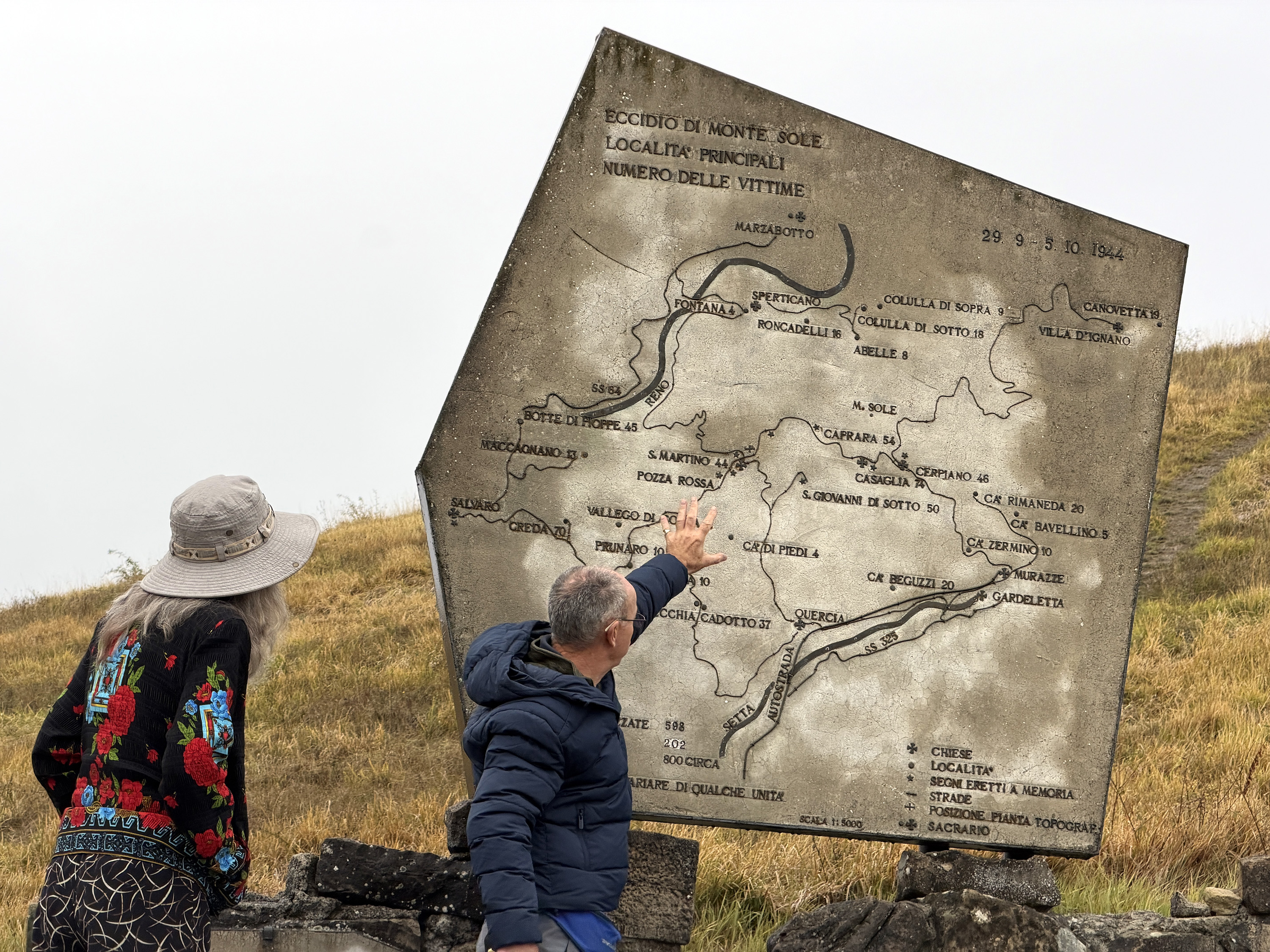
We started at the ruins of the tiny hamlet of Caprara di Sopra and then walked to the Casaglia church, where 90 people took shelter before they were marched to the nearby cemetery and gunned down and hand-grenaded. The parish priest was killed at the altar. At the cemetery, we saw where 89 were killed with machine-gun fire, including 39 children. The machine gunners aimed low, and you can see the spang about a foot off the ground because they were deliberately targeting the children. The massacre took place in the immediate rear of the fighting Fifth Army was then engaged in for the Gothic Line to the south. “Smiling Albert” Kesselring was initially prosecuted for this action because orders had come from his overall headquarters, but Alexander testified that he was a fair man and a decent opponent, and that the massacre was actually the responsibility of the SS. Major Reder was convicted of war crimes and served decades in an Italian prison before his release. The 16th SS was responsible for one-third of all of the civilian murders in Italy. We then drove to the town of Marzabotto, where there are numerous photos of victims in public areas and plaques describing many historic scenes of deaths, such as Coventry, Guernica, and Hiroshima. We had a sandwich lunch at Bar Caffè Della Piazza.


Stand 15 — Sasso Marconi (Praduro): Truscott Shifts from Route 65 to Route 64
The town of Praduro, the name appearing on many of the army maps, was renamed Sasso Marconi in the late 1930s. We attempted to visit the Marconi Museum and Mausoleum, but it turned out to be open only by appointment. Marconi’s grand house stands on the hill, above a structure of decidedly Fascist architecture with large staircases. We could see his tomb through a gate, and there is an inscription above it: “Diede con la sua scoperta il sigillo a un’epoca della storia umana” (meaning “With his discovery, he set the seal on an era of human history”). The tribute was composed by the renowned Italian poet Gabriele D’Annunzio but signed in the marble by Mussolini.


In the garden in 1895, Marconi connected a grounded antenna to a transmitter and was able to transmit radiotelegraphic signals beyond a physical obstacle, the Celestini Hill, at a distance of about two kilometers. The experiment marked the birth of the era of wireless communication. A large outdoor bust of the inventor has bullet spang on the back of his head. There is also a giant statue of him hiding behind a tree.


Returning to 1945, Frank reviewed the offensive up Highway 64 and the feint up Route 65. Highway 64, down the Reno River, offered a chance to outflank those works and break out west of the city. Once IV Corps took the Praduro road junction on 64, most of II Corps was to side-step west so both corps would enter the valley abreast. Shifting the weight of the attack to the west also let Fifth Army make use of the 10th Mountain Division’s specialized capabilities on the high ground around Monte Belvedere and Riva Ridge earlier that spring (Operation Encore, which we did not discuss).
Stand 16 — Santuario Madonna di San Luca: the Rush West of Route 64 and Entry into Bologna
We drove to Bologna to visit the hilltop sanctuary of San Luca high above the city. It is connected to the central city by a famous steeply climbing covered arcade used by pilgrims and churchgoers, next to which we drove up. The sanctuary overlooks the final approaches to the city from the southwest, and it was over this ground that Fifth Army’s advance west of Route 64 swept rapidly forward in the third week of April 1945. After the 10th Mountain Division and 1st Armored Division broke the mountain crust, the pursuit became a race. On April 21, elements of the 91st Infantry Division’s 362nd Infantry entered the city, while other units swung around on 64. The fall of Bologna marked the effective end of organized German resistance in the mountains and opened the Po Valley to the final, fast-moving weeks of the campaign.


We then went to the Polish cemetery, once at the wartime outskirts of Bologna but now right inside the city. It holds 1,432 soldiers of the Polish II Corps and is the largest of four Polish cemeteries in Italy, but it is rather unimpressive in comparison with its counterpart at Cassino, with mundane architecture that is not well maintained. We continued to Imola on Highway 9 and checked in at the Euro Hotel. Decent. Dinner at Trattoria Ca’ Del Pozzo, a busy truck-stop style restaurant with good food in large portions.

