Hal Jespersen’s Normandy DUKE Tour, October 2026 [Part 3]
These are my (Hal’s) notes from a specialized World War II tour of Normandy, hosted by Paul (Woody) Woodadge and Magali (Mag) Desquesne of the WW2TV YouTube Channel. “DUKE” (Dominion, United Kingdom, and Empire, a term coined by comedian/historian Al Murray) represents its focus primarily on British and Canadian actions in the Normandy Campaign. This is my second tour with Woody, the first a smaller-group tour in 2024. I also visited the area in conjunction with the 75th anniversary of D-Day. The notes that follow have been supplemented with some internet research on my part, such as unit designations; Woody’s narrative was not as geeky as this may seem.
Since this is a lengthy report with lots of photos (iPhone 17 Pro Max), I have broken it into three parts:
Contents – Part 3: British Airborne and Commandos, Bluecoat and Breakout

Tuesday, October 6 — British Airborne and Commandos
Timeline and summary of Normandy operation namesAlthough everyone knows that the British and Canadians had three landing beaches, Gold, Juno, and Sword, there was actually a fourth beach in early Overlord plans. Band Beach was to be to the east of the Orne River and Caen Canal, but the plan was not implemented. Instead, British airborne and commando troops were deployed to that left flank. Today we are covering aspects of their deployment, as well as one additional look at Operation Goodwood east of Caen in a single stop. It's another nice morning. We drove 50 minutes to the Église Saint-Pierre in Saint-Pierre-du-Jonquet in the Dives valley, the region known as Pays d’Auge, which is beautiful, bucolic, and quaint. The village lay on the eastern flank of the Allied lodgment, in the sector east of the Orne, but we came here to discuss a massacre. In July 1944, the Gestapo, working from lists of names, arrested resistance members and civilians who had sheltered British and Canadian 6th Airborne paratroopers dropped over the Dives marshes on D-Day. The prisoners were interrogated and tortured at Glanville, held at Pont-l’Évêque prison, and then taken to Argences before being driven to an unknown site and massacred.
Seven bodies were found in September 1944 in a bomb crater a few hundred meters from the village church, in a zone the Germans had restricted and used for V-1 preparation, and twenty-one more were found in November 1946, for a total of 28 victims. Seventeen have been identified, with ages ranging from 17 to 68, while eleven remain unidentified and lie in the village cemetery, where fragments of British uniforms suggest that some may have been Allied soldiers. A nearby monument by sculptor Gérard Laugeois, depicting three men shot while tied to a single post, was inaugurated on November 17, 1957, and a ceremony is held each year on the first Sunday after November 11.

A few miles away is Putot-en-Auge. On August 19, during Operation Paddle, the British 5th Parachute Brigade cleared the village. The hard fight was for Hill 13, the height east of the village that covered the road toward Dozulé and a position of the German 346th Infantry Division. The 13th Parachute Battalion was sent to take it, with about three-quarters of a mile of open ground in front of the hill. At 11:45 a.m., B Company reached the foot of the hill and stormed the first crest with bayonets. On the reverse slope they met fresh German reinforcements and machine guns and were driven off, and a flanking attempt by C Company also failed. The battalion held the lower slopes but did not take the summit that day, and the 13th alone lost about 70 killed, wounded, or missing, including B Company’s commander, Major Tarrant. We walked to Église Saint-Pierre, where there is a poignant small CWGC cemetery with 32 fallen from the fight.


We then stopped in nearby Dozulé for coffee and a rest break. This was the next German strongpoint on the road toward Pont-l’Évêque, held on the southern heights by the 346th Infantry Division. After Hill 13, No. 48 (Royal Marine) Commando moved around the slopes outside town on the night of August 20, then captured and held the town until morning. The Germans slipped out toward Annebault and set Dozulé alight, and at 4:30 a.m. on August 21, Nos. 41 and 48 Commandos entered a burning, empty town.
Twenty minutes later we reached Bénerville-sur-Mer and the Mont Canisy battery, StP 13 (Stützpunkt, or Strongpoint 13). On the drive, a guest guide named Elisa, traveling with us, told us about the history and culture of Normandy. We passed through the fashionable town of Deauville, which Elisa said is so elite that it is nicknamed the 21st Arrondissement of Paris. At 360 feet, Mont Canisy is the highest ground on this coast and looks into the Seine estuary and Le Havre. We walked up an extremely steep road to get to the top, and the views were fantastic, with Sword Beach and Le Havre in the far distance.


The Germans put six captured French 155 mm guns here, with a range of 19 km, later partly casemated in six 134Sk gun platforms (open mountings), with more than 2.5 miles of underground gallery that included a tunnel to Deauville. On D-Day HMS Warspite, Ramillies, and Roberts engaged the battery. But it lay outside the immediate invasion beaches and was largely bypassed during the initial landings, remaining in German hands and continuing to threaten shipping and the eastern flank of the beachhead until it was cleared during the general Allied advance along the coast in August, on the way to the Seine.


We had a sandwich lunch on the beach at Blonville-sur-Mer, then took a short drive to Église Notre-Dame-de-l’Assomption in Grangues. The Château de Grangues stands near the church. At the end of May 1944 the 744th Grenadier Regiment of the 711th Infantry Division occupied the château grounds and dug defensive positions around it. A couple of Stirling aircraft with engineers and airborne troops were hit by flak and crashed here around 1:00 a.m. on June 6. Around 1:30 a.m., four off-course Horsa gliders crashed in the château grounds.


The glider occupants were 6th Airborne Division men, including 591 Parachute Squadron, Royal Engineers. Survivors were rounded up by German patrols and marched to the local German company headquarters at the château, and eight unarmed British soldiers were later executed in the grounds. A memorial to the 52 men who died at Grangues stands by the church. Also at the church is a spring that supposedly has magical healing qualities. I took a sip and feel great.


Next was Église Saint-Firmin in Périers-en-Auge, overlooking the Dives Valley floodplain, which in 1944 was flooded to over a mile wide. We discussed the Operation Tonga bridge demolitions on June 6. One objective of the 6th Airborne Division was to destroy the bridges at Varaville, Robehomme, Bures, and Troarn. Together they closed the Dives crossings on the eastern flank, cutting off German reinforcement toward Sword Beach and the Orne bridgehead.


Early on June 6, two of the 6th Airborne Division’s Horsa gliders went badly astray and came down at Périers-en-Auge, about 10 kilometers east of Pegasus Bridge. Glider CN84, towed by an Albemarle, crashed into hedges at Saint-Evroult, 500 meters from the village center, but everyone aboard survived. CN94, carrying thirty men, landed near the Périers bridge after the pilot mistook the Dives for the Orne and the Caen canal. Its radio operator, Eric Everett, was shot dead and is buried at Ranville, and Private William Hedges, who died June 7, lies in the Périers churchyard. We then visited the Dives River bridge at Saint-Samson near Troarn, where a small memorial honors Major John C. A. “Tim” Roseveare, 3rd Parachute Squadron, Royal Engineers. His squadron’s job was to blow the five-span masonry bridges over the Dives. He parachuted at about 12:50 a.m., scattered well away from his planned drop point, and sent most of his sappers to blow the two Bures bridges. He then took a jeep and trailer of explosives toward Troarn with Lt. David Breeze and eight other men. The party hit a barbed-wire roadblock outside Troarn, and Roseveare drove straight through the town, which was held by the Germans, at about 30 mph under the load. At the bridge, half a mile beyond, he set a hasty demolition with Wade charges and blew a gap in the main span. This cut off German reinforcement and isolated the garrison in Troarn.

We made a rest stop in Troarn and viewed some local resistance memorials, then continued to Banneville-la-Campagne War Cemetery, where Woody read a Cyril account of the July 18 Goodwood actions. The village lies on the Goodwood corridor’s eastern side, near Sannerville, Cagny, and Émiéville, where the 11th Armoured and Guards Armoured Divisions met the 21st Panzer Division, and 1st British Corps was meant to widen the 6th Airborne bridgehead toward Troarn and Bavent. The cemetery holds 2,175 burials in total: 2,170 Commonwealth burials, 140 of them unidentified, plus 5 Polish graves. The Commonwealth burials are overwhelmingly British, with a few Canadians (11), Australians (5), and New Zealanders (2). Most of the men were killed from the second week of July, after the capture of Caen, to the last week of August, when the Falaise Gap closed. Goodwood (July 18–20) casualties are prominent, along with men from 70th Brigade killed near Esquay in mid-July, and there are also airmen, including Canadian Bomber Command crew buried beside their flight crews.

Our final stop was Pegasus Bridge over the Caen Canal in Bénouville. This visit duplicates my two previous tours, but it is always good to reinforce my memory. I have reused some text and photos from my 2024 report. At 12:16 a.m. on June 6, three Horsa gliders of Major John Howard’s D Company, 2nd Oxfordshire and Buckinghamshire Light Infantry, landed within yards of the bridge, and the coup de main (Operation Deadstick) took it in about ten minutes. Horsa Bridge over the Orne was taken the same hour. The bridge at the site today is a modern replacement of similar design, while the original now sits beside the Mémorial Pegasus museum.


Woody described the assault in detail, marveling that the first glider stopped within 90 yards of the bridge with the other two right behind. Lieutenant Den Brotheridge, shot by German machine-gun fire while crossing the bridge, was the first Allied combat casualty of Operation Overlord; Woody and other historians strongly suspect it was accidental friendly fire, though no published source will admit it. With the 21st Panzer only thirty minutes away, a Marder tank destroyer (it might have been a StuG) approached the bridge but was stopped by a British soldier with a PIAT hand-held antitank weapon, and the few remaining armored vehicles withdrew. The 7th Parachute Battalion held both bridges until Lord Lovat’s commandos arrived from Sword Beach with piper Bill Millin. Woody told humorous stories about Millin and about Wally Parr, who took over a German 50 mm cannon to threaten a patrol boat coming up the river and years later could not finish a BBC interview without cursing multiple times per sentence. Café Gondrée, 20 yards away, was the first house liberated in France; we ate there in 2024.
I had dinner with four newfound friends at La Rapière in Bayeux, and the food, service, and companionship were outstanding.
Wednesday, October 7 — Operation Bluecoat and the Breakout
Timeline and summary of Normandy operation namesOur final day was dark, gloomy, and rainy. We drove 30 minutes to Église Saint-Clair et Saint-Martin in Caumont-sur-Aure, where Woody started with an overview of Operation Bluecoat, the British offensive of July 30 to August 7. It was launched west of Caen on short notice, south of Caumont, to do two things at once: seize the road junction at Vire and the high ground of Mont Pinçon, and support the American breakout in Operation Cobra on the western flank. The Germans had pulled the 2nd Panzer Division out of that sector to counterattack the Americans (Operation Lüttich), and most of their remaining armor was tied up against the British and Canadians farther east around Caen (Operation Goodwood). Bluecoat was meant to exploit that gap and keep German armor fixed on the British front.

Caumont is on high ground in the gap in the line between the American V Corps and the British sector. The U.S. 1st Infantry Division took the town on June 13, and the Americans held it through the bocage fighting of June and July. For Bluecoat, the British VIII Corps (11th Armoured Division, Guards Armoured Division, and 15th Scottish Division) and XXX Corps (43rd Wessex and 50th Northumbrian Divisions) attacked south from the Caumont sector on July 30. The terrain ahead was very difficult, known locally as Swiss Normandy, with deep valleys and tight bocage and sunken lanes that slowed the advance and made the early days costly despite the American flank cover. The Germans had worried about a June offensive here, but the famous storm in the Channel disrupted Allied supplies and reinforcements.
We drove south to Hill 226 near Les Loges. On the first day of Bluecoat, July 30, the 3rd (Tank) Battalion, Scots Guards was ordered to seize the hill, a small ridge several miles behind German lines. The battalion was equipped with Churchill tanks and belonged to the 6th Guards Tank Brigade, an independent brigade attached to different infantry divisions as needed. That means it was not part of the Guards Armoured Division, although it was soon to be reassigned to it. The battalion had inadequate artillery support. It reached the hill, but then three German Jagdpanther tank destroyers knocked out twelve Churchills, and twenty-four men were killed. S Squadron had to be pulled out to reform after its losses on Hill 226, so the battalion fought with two squadrons into early August.


Next came Hill 309, the 6th Guards Tank Brigade’s other objective on July 30, alongside Hill 226. The brigade’s tank battalions, the 4th Coldstream Guards and the 3rd Scots Guards, supported the 15th (Scottish) Division. When the advance slowed against the German 326th Infantry Division, the tanks pushed through, and the Coldstream tanks reached Hill 309 by 4 p.m. The Germans counterattacked and pushed the Coldstream and the 2nd Glasgow Highlanders off the hill at one point, but the British retook it soon afterward. The 4th Coldstream war diary records that on August 2 the brigadier, Sir Walter Barttelot, visited the battalion, congratulated each squadron, and said the hill would be known as Coldstream Hill. He also told them the Germans had nicknamed them “Churchill’s Butchers.” We drove past a roadside memorial to Barttelot, who was killed on August 16.

At Saint-Martin-des-Besaces, after Hill 309, the Guards Armoured Division attacked this large crossroads village from which roads led off in every direction. We took a coffee break, and Woody gave an overview of Cobra for context. He convinced us that Cobra and Bluecoat should really be considered a single operation.
Bull Bridge, also called Dickie’s Bridge, near La Ferrière-Harang is the intact D56 crossing of the Souleuvre River in a deep valley. The 11th Armoured Division broke through here on the second day of Bluecoat, July 31. Patrols of the 2nd Household Cavalry in two armored cars (a Daimler and a Dingo), led by Lt. Derek “Dickie” Powle and probing ahead of the 159th Brigade Group, found the bridge intact and the lane leading to it undefended. It was a wild story of how they got in behind a German staff car trailing dust and penetrated six miles behind enemy lines without anyone noticing. The lane lay on the boundary between two German divisions, the 3rd Parachute and the 326th Infantry, and radio intercepts showed the two commands were confused and disputing which was responsible for guarding it. The Household Cavalry held the bridge for two hours, until a troop of tanks from the 2nd Northamptonshire Yeomanry joined them. The division then crossed and pushed south, and Le Bény-Bocage fell on August 2. The bridge name comes from the black bull emblem of the 11th Armoured Division.


In Souleuvre en Bocage we lunched at the Irish Corner Pub and Cave. We missed the local Mexican festival by one day.

Ondefontaine was an objective of the 43rd (Wessex) Division in the Mont Pinçon fighting, which formed the XXX Corps part of Bluecoat. The 4th Battalion, Dorsetshire Regiment led the brigade through sunken bocage lanes between La Bigne and Ondefontaine under increasingly heavy mortar fire. Two ex-DD Shermans of the Sherwood Rangers Yeomanry’s C Squadron, from the 8th Armoured Brigade, supported them. We did not get out in the rain, but Woody read a brief description of the action.
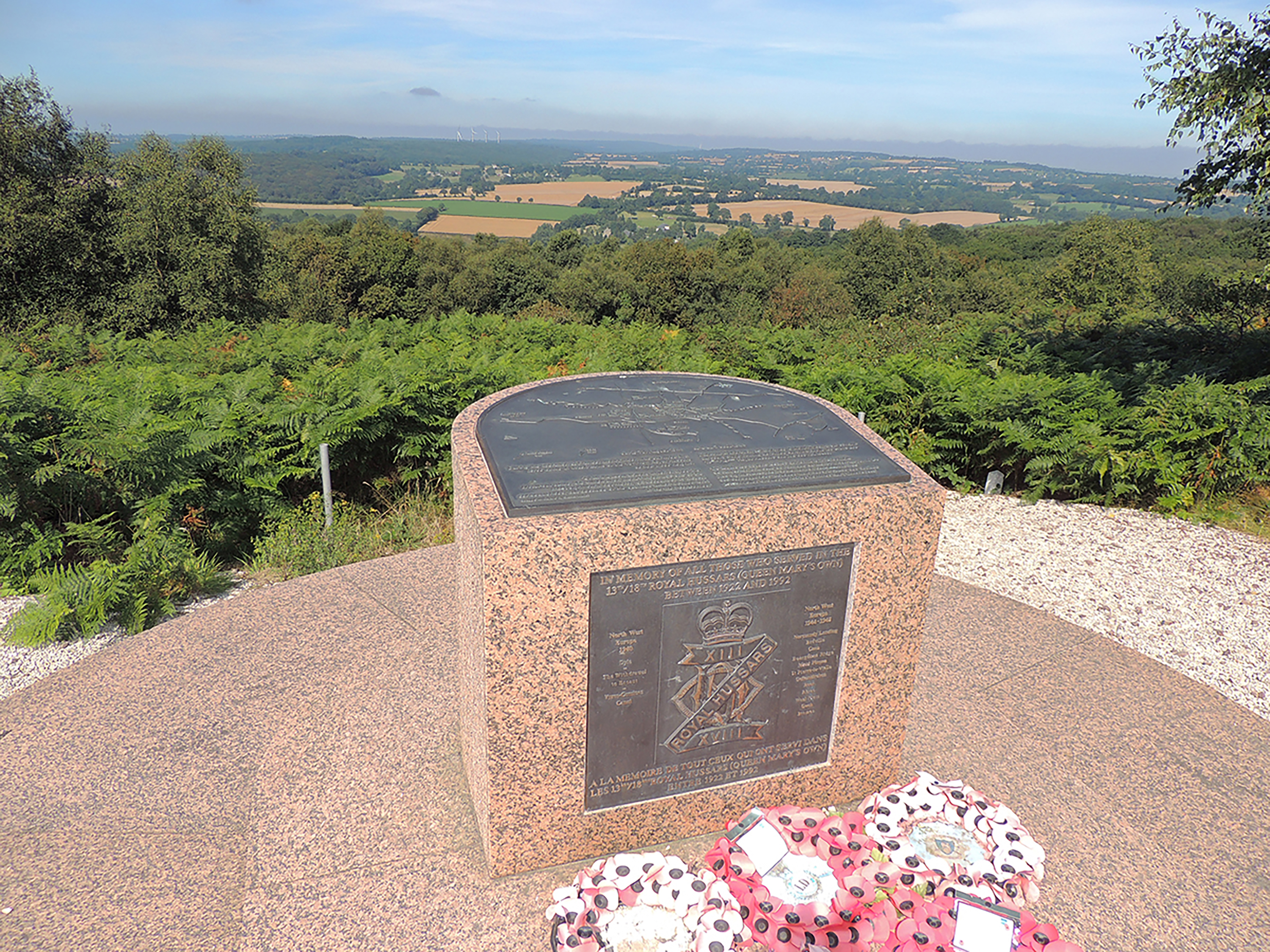
At 1,198 feet, Mont Pinçon is the highest point in Normandy, and the Germans had built a Luftwaffe radio-control station here in 1940. The 13th/18th Royal Hussars (Queen Mary’s Own), part of the 8th Armoured Brigade, which supported the Wessex Division, attacked on August 6 but stalled under mortar and machine-gun fire from the German 32nd Infantry Division on the mountain. Late that afternoon the Hussars’ tanks reached the summit by a farm track from the village of La Varinière, while the 4th Somerset Light Infantry (129th Brigade) fought up the wooded slopes alongside them. At dawn on August 7 the British destroyed the German installations on top and took more than 200 prisoners. The German line from Vire to the Orne was now unhinged, and they began a hasty retreat that would end up in the Falaise pocket. On a clear day the view still runs to the sea, but this was not that day. We spent five minutes at the summit monument to the Hussars and then retreated to the bus. The clear photo below is from a tourist website.
We followed the Nottinghamshire (Sherwood Rangers) Yeomanry route to Berjou. They fought through the bocage with the 8th Armoured Brigade and, in mid-August, came south to the Noireau River. Operation Blackwater (August 15–17) was the fight for the heights and the Col de Berjou. Berjou, on a steep ridge above the river, was one of the last German positions blocking the southern exit of the Falaise pocket. The Shermans were held at the foot of the climb, and on August 16 the regiment took the ridge at high cost. Woody read an account of Lt. James Francis “Frank” Galvin, a British tank officer killed on August 16 on the heights of Berjou. He served with C Squadron of the Sherwood Rangers Yeomanry. On August 15 the Rangers were held up behind the Noireau, and that evening Galvin, aged 24, wrote a last letter to his wife, Maud. The next day his Sherman missed a turn meant to bypass the village, came face-to-face with German defenses at the entrance to Berjou, and was hit by a Panzerfaust or an antitank gun. (Woody showed us a photo of a live loaded Panzerfaust discovered nearby just two weeks ago.) The tank burned, killing Galvin and his crew, and their remains were indistinguishable. They are buried together in Banneville-la-Campagne War Cemetery, southeast of Caen.


The Blackwater Museum (Musée de la Libération) in Berjou was founded in 2011 by Romain Bon after he picked up cartridge cases in the village and asked the old men what had happened. The museum, now run with his son Louis, is built on local finds rather than purchased collections. It recovered the forgotten name of the battle, Blackwater, from the River Noireau, and tied it back to the Sherwood Rangers. It has hundreds of artifacts and a brief movie. The museum holds Galvin’s last letter and Maud’s reply, which came back stamped that the recipient was deceased and has remained sealed for more than 80 years, by the family’s wish. Historian James Holland located the burned-out tank site in a hedgerow near the village, and a steel silhouette memorial to the nine men was inaugurated at the museum in August 2025.


Our final stop on the way north to Bayeux was at Église Saint-Samson in Aunay-sur-Odon. The crossroads town, along with the high ground of the Monts d’Aunay, was an objective for XXX Corps during Bluecoat, approached by the 50th Northumbrian and 43rd Wessex Divisions. Like so many small Norman towns astride the Allied line of advance, Aunay was almost completely destroyed by bombing and artillery fire before it was finally entered in early August, a fate shared with Saint-Lô, Villers-Bocage, and Caen itself. Woody thinks it was 90 percent destroyed, the most of any town in France. It was a sobering way to think about the cost of the war, not just to the soldiers but to the helpless civilians.

We ended with a farewell dinner at Brasserie des Ducs, an appropriate end for the DUKE tour. On Thursday morning, I drove back to Paris CDG and took an afternoon Air France flight to Bologna, Italy. My World War II tourism continues Friday at the Gothic Line.
I had an excellent time with Woody and the gang on this DUKE tour. I learned a lot, and there was very little overlap with my previous visits to Normandy. Mag did a great job on logistics and provided some important color commentary outside the strict military tactical field. The 25 participants were all great, friendly guys and gals. I don’t know when I will be planning another visit to Normandy because this has been a very comprehensive experience, so my thirst for knowledge has been quenched for now (and I am sorry to say that I am not getting any younger). I tried to put a bug in Woody’s ear about doing an Operation Market Garden tour, and he seemed interested, but time will tell.