Hal Jespersen’s Normandy DUKE Tour, October 2026 [Part 1]
These are my (Hal’s) notes from a specialized World War II tour of Normandy, hosted by Paul (Woody) Woodadge and Magali (Mag) Desquesne of the WW2TV YouTube Channel. “DUKE” (Dominion, United Kingdom, and Empire, a term coined by comedian/historian Al Murray) represents its focus primarily on British and Canadian actions in the Normandy Campaign. This is my second tour with Woody, the first a smaller-group tour in 2024. I also visited the area in conjunction with the 75th anniversary of D-Day. The notes that follow have been supplemented with some internet research on my part, such as unit designations; Woody’s narrative was not as geeky as this may seem.
Since this is a lengthy report with lots of photos (iPhone 17 Pro Max), I have broken it into three parts:

Wednesday/Thursday, Sept. 30/Oct. 1 — to Bayeux, Normandy
I flew United Airlines nonstop from San Francisco to Paris (CDG), with a scheduled departure in the mid-afternoon on Wednesday. This itinerary brought back bad memories. Back in 2024, after a delayed departure, the plane had problems in flight, and after two other flights and a hotel stay in Denver, I wound up arriving in Paris a day late. My suitcase got stuck in inter-airline purgatory and arrived in Normandy three days after that. This flight continued the pattern. We were delayed nine hours because the galley ovens weren’t working, so a new plane and crew had to be found, and we finally departed at 11:30 p.m. Not an auspicious start.
I arrived at CDG on Thursday evening, and the EES (Entry/Exit System) line was a mess. About 150 people were ahead of me, all of the kiosks were down, and only three clerks were processing arrivals. It took 45 minutes to get through, and roughly 300 people were still in line behind me when I left.
I rented a car from Avis (a Dacia “Bigster” hybrid) and drove three hours to Bayeux. I was a bit apprehensive because I have a Tesla at home with full self-driving, and I have hardly driven myself at all in the last nine months, certainly not more than a couple of miles. It was interesting to see that the French have upgraded their autoroutes so that the frequent toll booths are gone and everything is done through license plate recognition and a website for payment—they call it flux libre. I checked into the Hotel Belle Normandy in Bayeux just before midnight, the same hotel (and room) I stayed in back in 2024. The group met at 6 p.m. for a get-together, but I obviously missed that.
Friday, October 2 — Gold Beach and Inland
Timeline and summary of Normandy operation namesThe day began with beautiful, cool weather. I met our 34-passenger bus at the Memorial Museum of the Battle of Normandy, a five-minute walk from my hotel. There are 25 guests on the tour, about a third of them American. Our route took us through Arromanches, where we saw the area of the radar station that Allied gunfire had targeted, and then to the beach at Asnelles. Woody gave us an overview of the week. We will not go laterally beach by beach but will instead follow units inland from each one.

Viewing the Mulberry ruins offshore, Woody’s opinion was that the artificial harbor was an insurance policy that proved not to be fully necessary. He described Gold Beach, with dunes and marshes, as the forgotten beach, eclipsed in reputation by the other four beaches. In his view, Allied success in Overlord was mostly inevitable, given the heavy naval gunfire and the disparity in forces of roughly 156,000 versus 23,000 defenders. The Jig sector here was assaulted by the 50th (Northumbrian) Infantry Division and the 8th Armoured Brigade, under XXX Corps, with the 231st Brigade among the units landing. Woody divides the campaign into three phases: beachhead, attrition, and breakout. We viewed the 88mm casemate where the 147th Essex Yeomanry disabled it with a Sexton self-propelled 25-pounder gun on an M4 carriage. Woody noted that German bunker construction was inferior in 1944, but this one had survived mostly intact. The bullet and shell indentations in the concrete he described using the neologism “spang.”


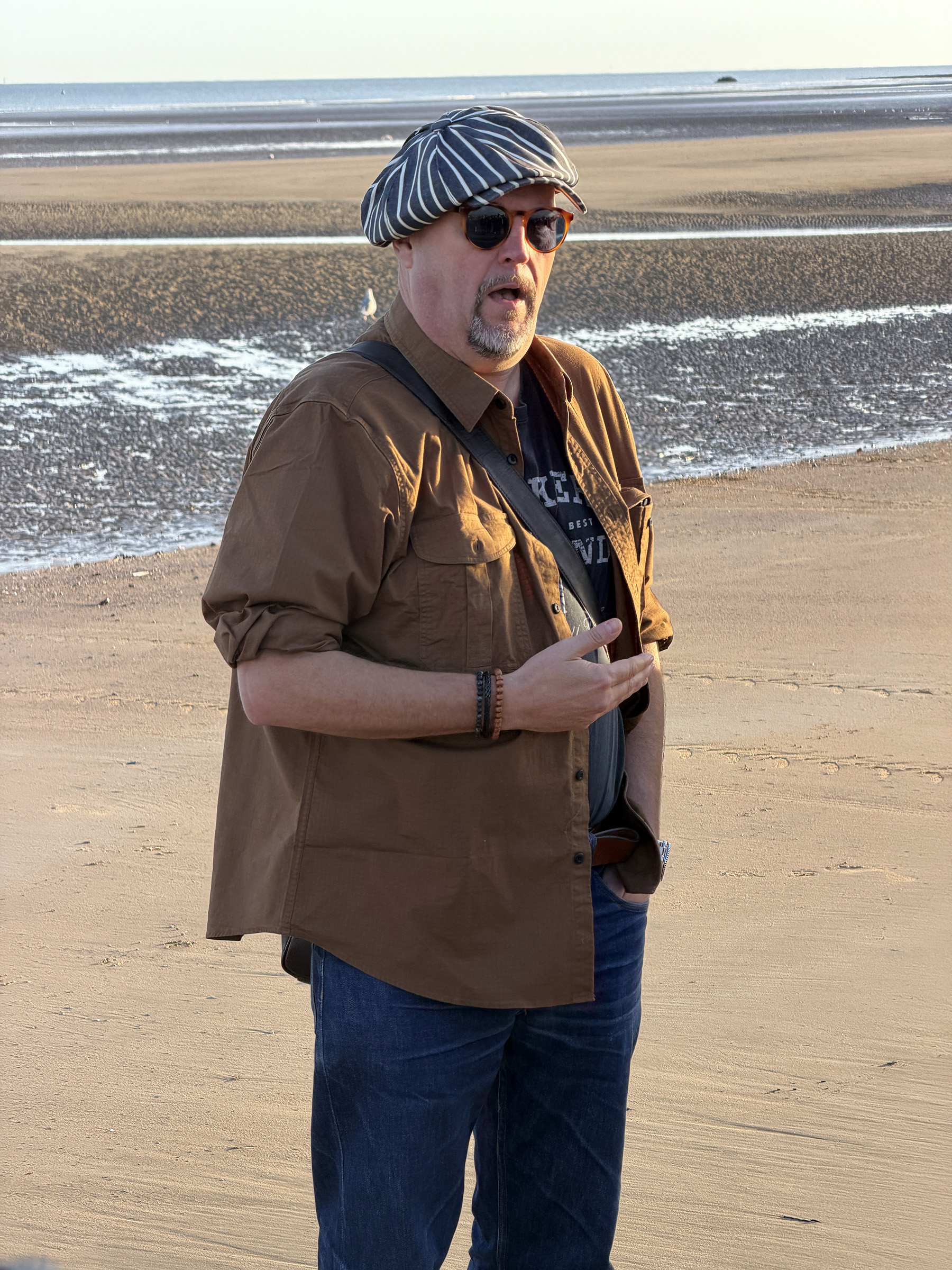

We spent an hour at the British Normandy Memorial near Ver-sur-Mer. It commemorates the service personnel who died under British command in the Normandy campaign, a total of 22,442. Dozens of columns carry the names, ranks, and ages of the men who died. Many British veterans have criticized the design as too grandiose, and Woody said that if you put a swastika on top, it would look like an Albert Speer building.


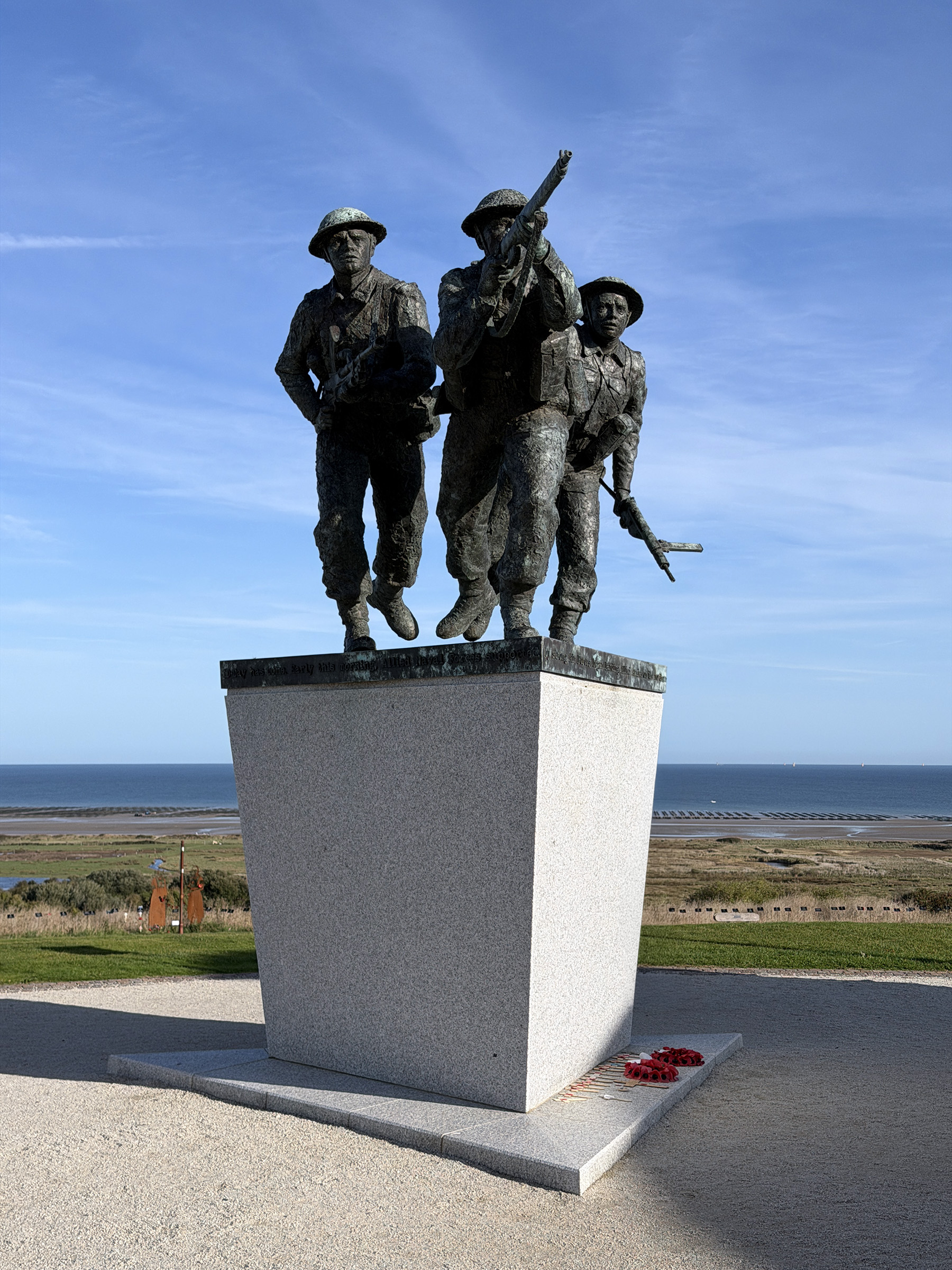


The grounds are also the site of Standing with Giants, an installation of steel silhouette figures representing fallen soldiers, but they had been removed for the winter. Nearby is the Winston Churchill Center, which has a gift shop, a café, and superficial exhibits about Operation Overlord.


Crépon, south of King sector, was the first inland battle area beyond the dunes. There we visited the Green Howards monument, which features a very evocative statue of an exhausted soldier and an information panel about the 69th Infantry Brigade. The Green Howards (formally Alexandra, Princess of Wales’s Own Yorkshire Regiment) were an old county regiment recruited from the North Riding of Yorkshire, and their 6th and 7th Battalions landed on Gold Beach on D-Day as part of the 69th Brigade of the 50th (Northumbrian) Infantry Division. We heard the story of Company Sergeant Major Stanley Hollis of the 6th Battalion, who Woody described as “muddling through the war” yet earned the only Victoria Cross awarded on D-Day. (In the British Army, a company sergeant major is the equivalent of a U.S. first sergeant.) Afterward we passed the Bazenville airfield and the Château de Creully, which served as Montgomery’s headquarters.


In Cristot, we visited St-André Church. The village was razed in an eight-day battle, in the manner of Verdun, and a visibly ruined section of the church has been retained. We then drove to a minor high ground, Point 103 (Le Haut d’Audrieu), which gave us an expansive view of St-Pierre, the area known to the Brits as Lehr Ridge. Here the Panzer Lehr Division, led by Fritz Bayerlein, stood its ground against attacks by the Sherwood Rangers Yeomanry during Operation Perch. The battle swung back and forth for weeks. One of the guests read portions of his father’s diary from the 24th Lancers. We also discussed the lack of tactical air support in this part of the battle, because the planes were first concentrating on destroying German reinforcements approaching the campaign area.


In Tilly-sur-Seulles we saw Woody’s all-time favorite monument. It is hidden away on a side street, on the side of a wall, and consists of a large number of unit patches carved in stone. We then had a baguette lunch in the pretty little town center. From June 7, Tilly was the hinge between Bayeux and Caen. Panzer Lehr and the 12th SS used it as a launch pad, while the 50th and later the 49th Divisions had to have it. The village changed hands many times between mid-June and early July. About three-quarters of the built-up area was destroyed, and roughly one inhabitant in ten was killed.


At Fontenay-le-Pesnel, we jumped ahead two weeks to the start of Operation Epsom. A Sherman fought a Panzer 6 Tiger here, and it took ten shots to knock out the big cat. The town was the left objective of Operation Martlet (Dauntless) on June 25–26, the flank guard for Epsom. The 147th Brigade of the 49th Division attacked the 3rd Battalion, SS-Panzergrenadier-Regiment 26 of the 12th SS Hitlerjugend, which had been in Fontenay since the evening of June 7. The SS fell back on Tessel and Rauray. Near Tessel, we saw the 49th (West Riding) Division Memorial, which has a polar bear logo. The Fontenay-le-Pesnel War Cemetery, also near Tessel, holds 460 Commonwealth graves, many of them men of the South Staffords, East Lancashires, Warwicks, and Durham Light Infantry, along with 59 German graves.


In Tourville-sur-Odon, we visited the Église Sainte-Trinité, which has a small memorial outside to the 15th (Scottish) Division and Operation Epsom. Woody compared the difficulties of attacking here, in rolling hills with villages surrounded by stone walls, with those of the Americans in bocage country. The British were up against nine tanks for every one the Americans faced in their sector; Caen was an absolutely essential crossroads city for the Germans to retain.

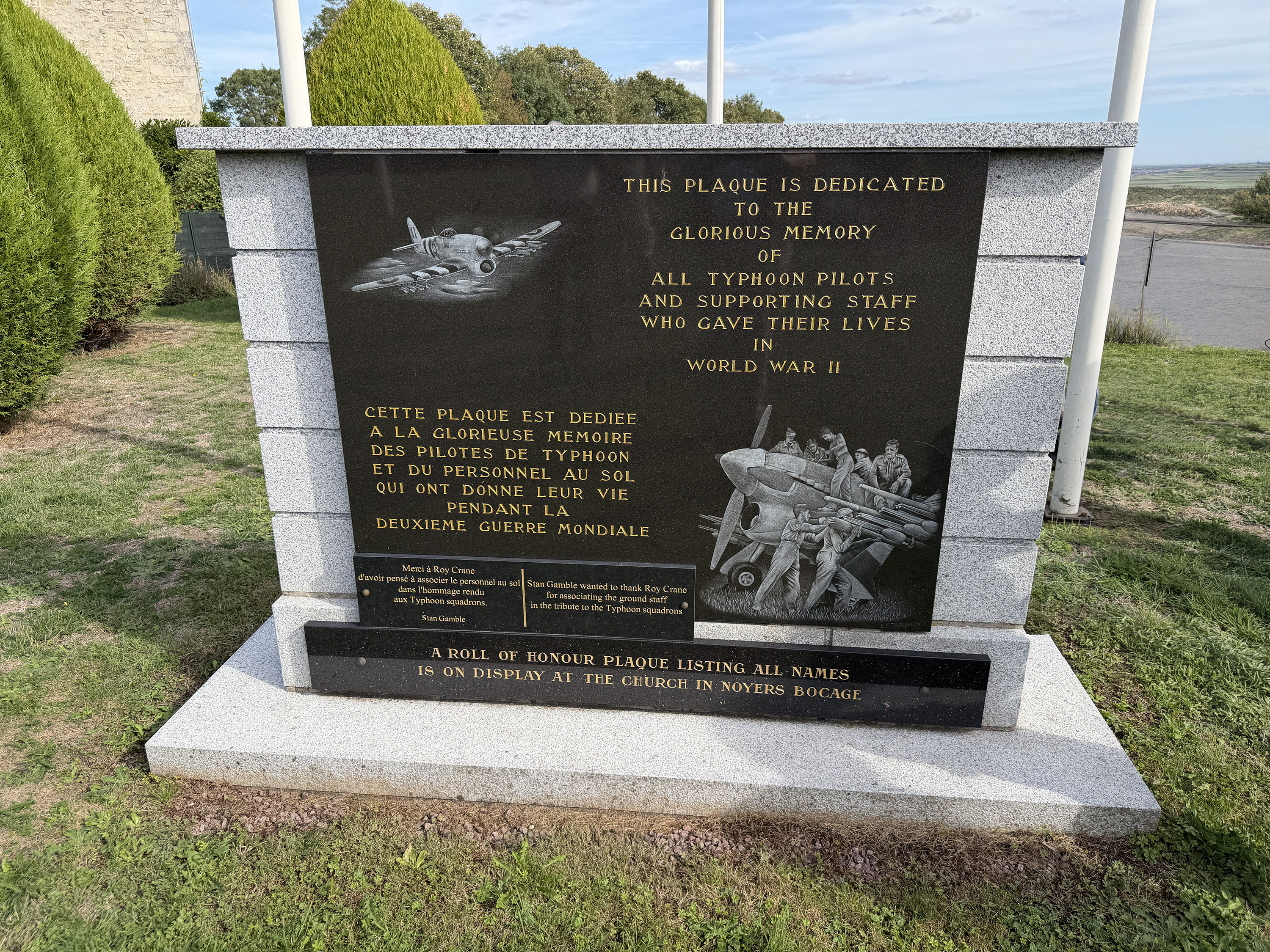
At Noyers-Bocage, we saw a memorial to the Typhoon pilots, whose casualty rate was higher than that of kamikaze pilots (because the latter often had insufficient planes to fly). A total of 151 died in Normandy. We then drove over Rauray Ridge and back to Tilly for a rest stop. In Lingèvres, Woody talked about various tank duels and the advance of the 9th and 6th Durham Light infantry. There is a monument to the DLI, which raised 19 battalions for the British army. The battle lasted five hours.



Our last stop was Ellon, site of airfield B12, one of 27 tactical airfields built in the first weeks after D-Day. A number of plaques commemorate pilots who lost their lives flying from it. We then had some time to freshen up and walked to a nice bistro, La Maison Bayeux, for dinner. It is a few blocks away from the Bayeux Cathedral, which, in normal times, houses the famous Bayeux tapestries, but they are currently on exhibition in the British Museum in London.

Saturday, October 3 — Juno Beach and Inland
Timeline and summary of Normandy operation namesToday the Canadians took the spotlight, and Woody’s theme was that they punched above their weight in Normandy. Almost everything today was a new experience for me. We drove thirty minutes to Bernières-sur-Mer, in the Nan White sector. Juno Beach ran from La Rivière to Saint-Aubin-sur-Mer and was assigned to the 3rd Canadian Infantry Division and the 2nd Canadian Armoured Brigade. Woody discussed the hidden sandbar that blocked larger ships and restricted the DD tanks. The sea wall stood about seven feet above the sand, but it is less of an obstacle today. Canada put one small division ashore on the second-broadest beach, and the first wave suffered severe losses, but the landing was successful overall.


At the Queen’s Own Rifles of Canada (QOR) memorial, we learned that the regiment landed on Nan White against Widerstandsnest (WN) 28, which the preliminary bombardment had barely touched. The position included a bunker with a 5-cm KwK 38 (Kampfwagenkanone, originally built for a Panzer III), three Tobruk ringstand pits (small circular concrete positions open at the top), and various machine-gun emplacements in house basements. The QOR suffered the highest Canadian regimental loss of the day, with 61 killed and 82 wounded. They still reached their inland objective of Anisy, seven miles south, that evening, the only Allied assault battalion to do so. We also stopped outside Canada House (Maison des Canadiens), almost certainly the first house or hotel liberated on D-Day. On a window sill was a pile of rocks called an inukshuk, a Canadian Inuit memorial, the first of a number of them we saw today.


We drove south to Tailleville, and on the bus Woody discussed Operation Fortitude, the deception operation that protected Operation Overlord. WN 23 consisted of a stone wall and Tobruks at the end of a giant open field, and the battle for it lasted seven hours. We walked to Place Alfonse Noël to see a small Tobruk. Woody emphasized how difficult progress remained even after the beach, and I gained a better appreciation of how deep the Atlantic Wall actually was. We drove past a Luftwaffe radar station, one of the strongest inland fortresses in the sector, and then a memorial to the Norwegian personnel who served in the campaign, including two squadrons of Spitfire pilots.
Our next stop was Villons-les-Buissons (“Hell’s Corner”). On the evening of June 6, the North Nova Scotia Highlanders of 9th Brigade, in reserve for the beach assault, reached the northern edge of Villons. They took the village at dawn on June 7 with Sherbrooke Fusilier tanks and pushed on toward Buron and Authie, aiming at Carpiquet airfield, the unfulfilled Canadian D-Day objective. Woody related that two infantry brigades numbered 9th (one Canadian and one British), with two brigade commanders each named Cunningham, were moving forward side by side, causing a lot of communications confusion. After the disaster at Authie, the Highlanders fell back to Villons and turned it into a “brigade fortress,” which they called Hell’s Corner. In their fortress, the 9th Brigade would resist repeated German counterattacks and heavy shelling for a whole month. The costly but successful attacks on the Carpiquet aerodrome, launched on July 4, finally broke this stalemate. The rest of our morning involved some particularly gruesome events…

At Authie on June 7, the North Novas and Sherbrooke Fusiliers drove through Buron into the village. Kurt Meyer, commander of the 12th SS Panzer Division “Hitlerjugend,” watched from the tower of the Abbaye d’Ardenne and launched the 25th SS Panzergrenadier Regiment against them. Canadian tanks were knocked out in the streets, 13 of 17 Shermans were destroyed, and the infantry was overrun. We visited the corner named Place des 37 Canadiens for the men murdered there that day, who were repeatedly run over by tanks until the streets ran with blood. Losses for the battle group came to about 110 killed, 64 wounded, and 128 taken prisoner, worse than for any other Canadian battalion. In Église Saint-Vigor, we heard the story of a Canadian officer who hid in the confessional booth and was so terrified that he subconsciously ripped parts off the window to the priest, which medical personnel later had to pry from his hands. His son eventually returned those wooden parts to the church.


The Abbaye d’Ardenne became the headquarters of Meyer’s 25th SS Panzergrenadier Regiment on June 7 because its tower looks over the whole Canadian approach to Caen. That evening, eleven Canadian prisoners from the North Novas and Sherbrooke Fusiliers were taken into the garden next to a barn and shot in the back of the head. Each man was forced to walk over the bodies of the preceding dead. On June 8, seven more North Novas captured around Authie and Buron were killed the same way. Twenty Canadians in all died here between June 7 and 17. Meyer was later convicted of war crimes and sentenced to death, although he left prison after only seven years. Woody related a story from another guide who said Meyer had the gall to show up for a battlefield tour! The SS abandoned the abbey on the night of July 8–9 during Operation Charnwood, and the Regina Rifles occupied it at dawn.


We had lunch at the bistro Le Comptoir du Malt in Saint-Contest. After lunch we jumped ahead in time to late July by driving south of Caen, where the ground rises to Verrières Ridge, which dominates the Caen–Falaise road. Point 67, just north of Saint-Martin-de-Fontenay, is the northern spur. The Calgary Highlanders and Sherbrooke tanks took and held it after Operations Atlantic and Goodwood in mid-July. On July 25, Operation Spring was meant to take the ridge and fix German armor in place at the same time the Americans launched Operation Cobra. It became one of the costliest Canadian days of the war, with about 1,500 casualties, some 500 of them dead. The ridge was not securely Canadian until Operation Totalize on August 7–8. We enjoyed the expansive view and the Memorial to the Royal Regiment of Canadian Artillery, which features a nicely maintained 25-pounder towed gun. Woody described Guy Simonds, commander of II Canadian Corps, as having very inventive tactics but not being admired by Montgomery.


We drove to May-sur-Orne and took a long walk along an open field to see where, on July 25, the 1st Battalion of The Black Watch (Royal Highland Regiment) of Canada was ordered to seize Verrières Ridge during Operation Spring. Lieutenant-Colonel Stuart S. T. Cantlie, the commanding officer, was killed early that morning in fighting around Saint-Martin-de-Fontenay, and command passed to the very young Major Philip Griffin. The battalion had lost most of its promised tank support, and a delay forced the assault into daylight, but Griffin led it forward across open wheat fields toward the ridge. German artillery, mortars, and machine guns cut the advance to pieces, radio contact was lost within minutes, and only a handful of men reached the crest before a counterattack by the 272nd Infantry Division and elements of the 9th SS overran them. Griffin was killed with the leading companies. Of roughly 320 to 325 men who advanced, about 315 were killed, wounded, or captured, around 129 of them dead, leaving barely 15 to 20 fit for duty the next day. It was the battalion’s worst single day since Dieppe. We visited a modest, recently installed monument to the battle, and Woody called it an appalling, WWI-like battle.


In the village of Verrières, the Royal Hamilton Light Infantry of the 2nd Canadian Division attacked and captured the village on July 25, a key point for the Allied breakout from Caen toward Falaise. They were the only Canadian regiment to take their objective and hold it for seven days against intense fighting and repeated counterattacks by the 1st SS Panzer Division. The cost was 200 casualties, including 53 killed.

We then went back in time again to Troteval Farm. From July 18, during Operation Atlantic (part of Operation Goodwood), the Fusiliers Mont-Royal were ordered to seize the ground between Ferme Beauvoir and Ferme Troteval at Saint-Martin-de-Fontenay and to capture Verrières. On July 20, the three companies advanced on empty stomachs, 150 meters behind a rolling artillery barrage, and took their objectives. The next day, armor of the 1st SS Panzer Division Leibstandarte Adolf Hitler counterattacked and surrounded them. Cut off from supplies and reinforcements, Companies B and C were destroyed, but their stand allowed reserves to retake Ferme Beauvoir on July 24 and Ferme Troteval on July 25.

We continued to Cintheaux for the Bretteville-sur-Laize Canadian War Cemetery, the principal Canadian cemetery south of Caen. It holds 2,958 burials: 2,782 Canadian (87 unidentified), 80 British, and a few others. Most died in late July around Saint-André-sur-Orne and Verrières, and in August during Totalize, Tractable, and the Falaise pocket, and almost every unit of II Canadian Corps is represented. There is a special memorial for Gérard Doré, who at 16 was the youngest Canadian killed in battle and probably the youngest in the Allied force. We found some of the graves from the Abbaye d’Ardenne massacre, as well as that of Major Griffin of the Black Watch. It is a lovely cemetery, with numerous flowers planted between the markers and maple trees dropping their fall leaves.


Near Saint-Aignan-de-Cramesnil, we stopped at the Bosquet des Libérateurs monument to talk about Operation Totalize and the death of the infamous Nazi tanker Michael Wittmann on August 8. Woody speculates that Wittmann deliberately wanted to go out in a blaze of glory because his advance of four Tiger tanks was suicidal. Totalize opened on the night of August 7–8 with a heavy Royal Air Force Bomber Command strike and a night advance by II Canadian Corps armored columns, including the first large-scale use of Kangaroo armored personnel carriers converted from Priest self-propelled guns. We saw an awesome aerial photo showing the myriad bomb craters covering the field. The attack pushed the front about halfway to Falaise and broke the German forward line, but it stalled after German resistance, counterattacks, and friendly-fire bombings. Totalize ended on August 11 and was followed by Operation Tractable on August 14, which helped take Falaise and seal the pocket.

Dinner was on our own tonight. I went to a pizzeria, Patanella, right next to the cathedral. Delizioso!